Press Release
Faintest planet ever imaged from Earth found after more than 10 years of hide-and-seek
15 July 2026
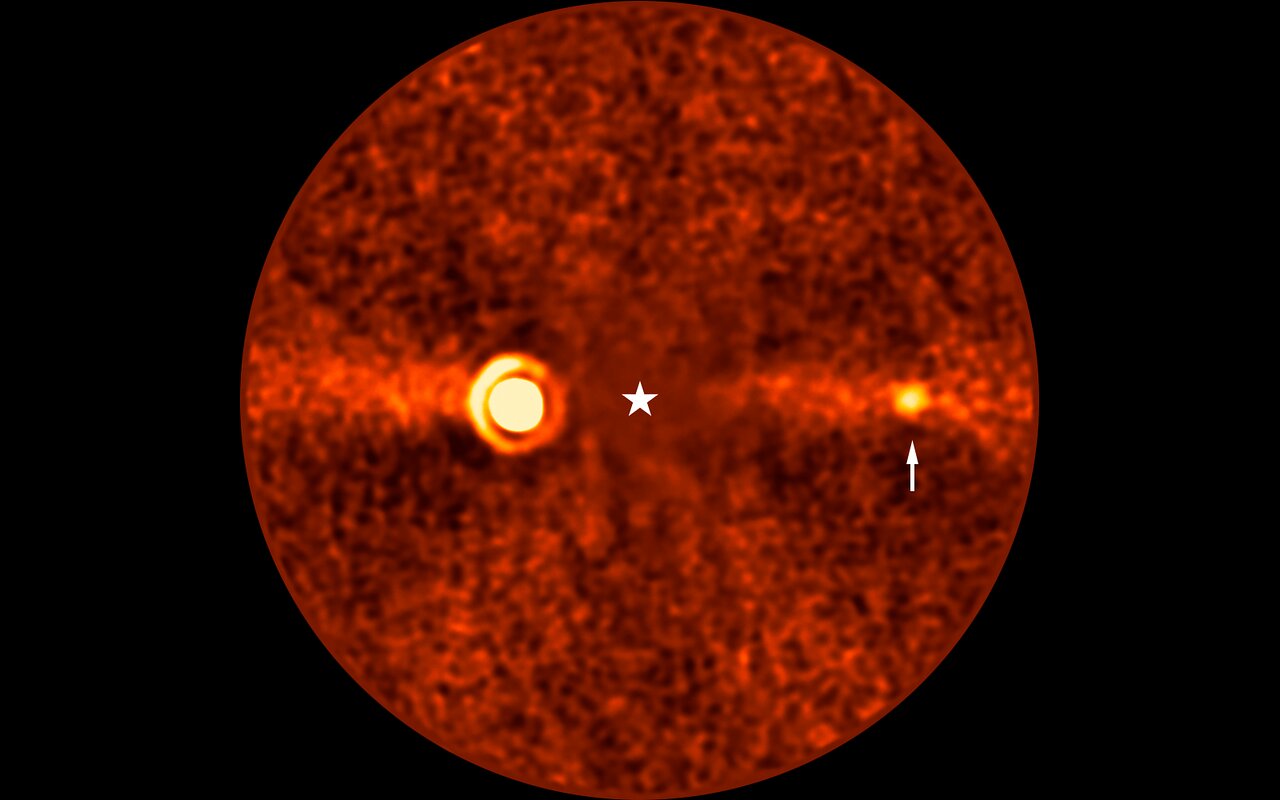
A team of astronomers have discovered a third planet orbiting the star Beta Pictoris. The new planet, Beta Pictoris d, is 100 times fainter than Beta Pictoris b — the first planet discovered in the same system — and is among the lightest exoplanets ever to be imaged from the ground. After spotting the planet using the European Southern Observatory’s Very Large Telescope (ESO’s VLT), the team found it had been hiding in archive observations spanning more than a decade.
“This was a serendipitous discovery,” says Ben Sutlieff, co-lead of the study published today in The Astrophysical Journal Letters and astronomer at the University of Edinburgh, United Kingdom. “We initially wanted to look more at a known planet in the system, Beta Pictoris b, to see how it changed over time,” he adds. However, when the team went to analyse their images of the system, they noticed something else, separated from Beta Pictoris b, that led them down an entirely new path.
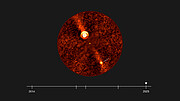
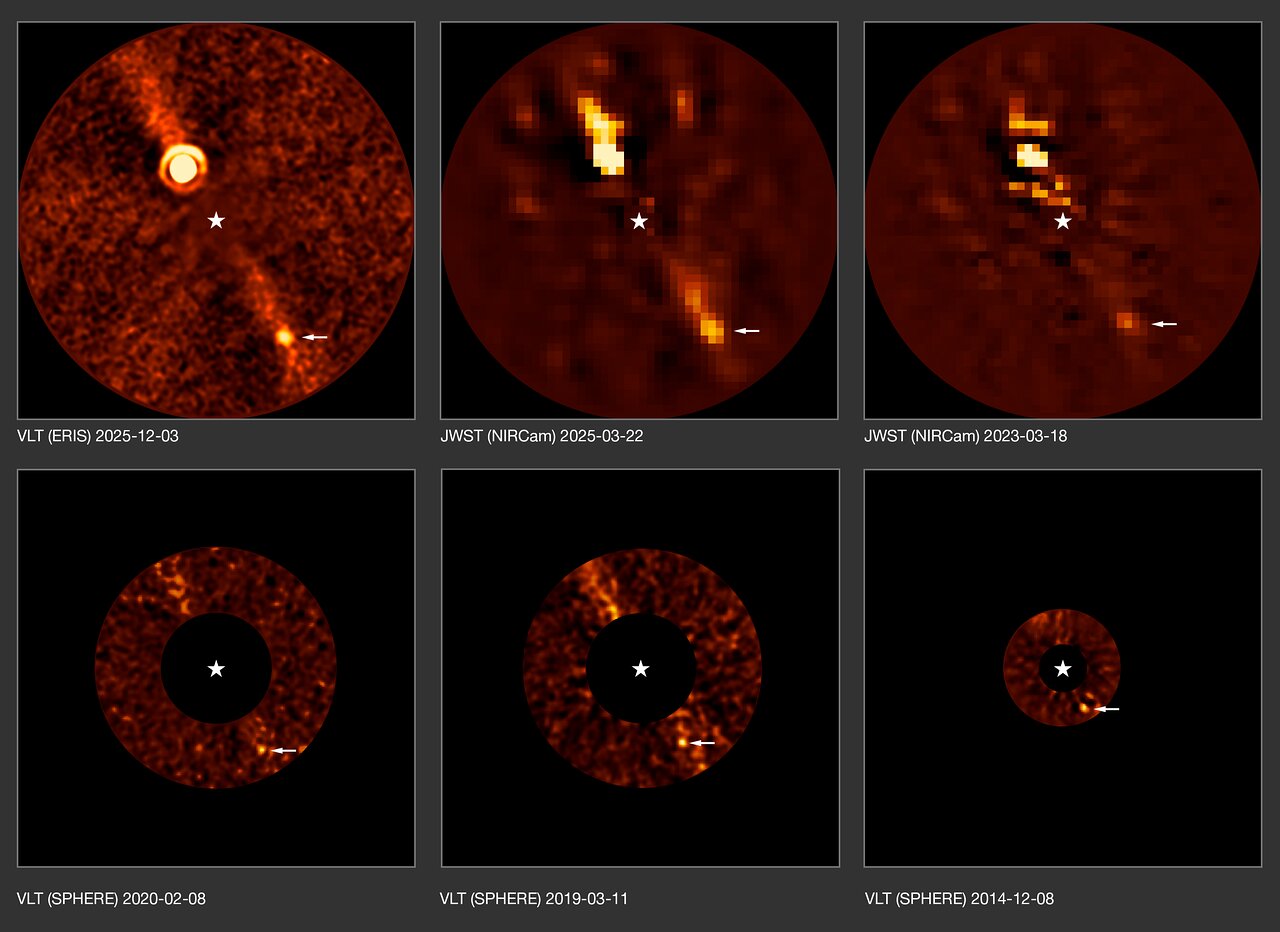
“‘There’s something else there, did you see it?’” Markus Bonse, ESO astronomer in Germany and the other co-lead of the study, recalls saying when looking at the data. To confirm the nature of their detection, the team looked through the ESO archive, a catalogue of past observations made with ESO facilities. They found a new planet, Beta Pictoris d, in multiple images dating back as far as 11 years ago, including one where it was only just visible against the glare of its larger neighbour Beta Pictoris b. “Planet d, it seems, has been playing a game of hide-and-seek with us for over a decade and only now can we say ‘found you!’” says Jayne Birkby, co-author of the study and astronomer at the University of Oxford, United Kingdom.
The newly discovered planet, like the two others in the system, is a gas giant like Jupiter or Saturn. However, Beta Pictoris d has a much wider orbit than the planets Beta Pictoris b and Beta Pictoris c. Moreover, while the first two planets are each around ten times the mass of Jupiter, the new planet is only 2.4 times more massive than Jupiter, making it one of the lightest ever imaged from the ground. The planet is also relatively cold and, hence, extremely faint relative to its host star.
Direct imaging, where the light from an object is captured as in a photograph, only works for planets bright enough to show up next to their much brighter host stars. Taking a direct image of a planet as faint as Beta Pictoris d, therefore, represents a significant achievement. “The new planet is 100 times fainter than Beta Pictoris b, the famous planet in the same system, making it the faintest exoplanet ever imaged directly from Earth,” explains Bonse [1].
This first clear detection of Beta Pictoris d, which is 63 light-years away from us, was made with the ERIS instrument on the VLT by Sutlieff, Bonse and their team. An independent team led by Aidan Gibbs at the University of California, US, also discovered the same planet using the James Webb Space Telescope (JWST), a facility of the US, European and Canadian space agencies. Their results are also published today in The Astrophysical Journal Letters.
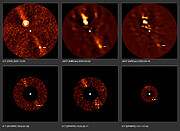
To confirm a planet’s discovery from a detection, astronomers usually have to make follow-up observations. However, this system had been extensively studied, with several images stored in the ESO and JWST science archives. “To our joy, out it popped in previous SPHERE observations,” says Birkby, referring to another VLT instrument previously used to observe the Beta Pictoris system. The planet was also spotted in archival observations from NIRCam, a JWST instrument. Now that the team knew where to look for the potential new planet, “it turns out it was hiding in the data all along!” says Birkby. Co-author Valentin Christiaens, researcher at CEA Paris-Saclay, France, adds: “The detections in the archival SPHERE data are not only very exciting on their own, but also because they suggest a number of treasures are still hidden in the archives of VLT instruments!”
Beta Pictoris is now the second system, after HR 8799, where more than two planets have been directly imaged. “Systems with multiple directly imaged exoplanets are the ‘holy grails’ of discoveries, because they can teach us a lot about what different exoplanets are like in the same formation environment,” says Sutlieff [2]. Beta Pictoris d also clears up a mystery in its planetary system, as it has exactly the right mass and position to explain the particular shape of the surrounding debris disc, made of the leftovers of planet formation.
The discovery of Beta Pictoris d in this way encourages further direct imaging of planetary systems where faint planets may have been hiding in plain sight, including with ESO’s upcoming Extremely Large Telescope (ELT). “Planets seem to have friends,” says Beth Biller, also a co-author of the paper and astronomer at the University of Edinburgh, “many of the famous directly imaged exoplanet systems seem to have multiple giant planets in the same system, and likely there are even more lower mass planets hiding in these systems that might be revealed with instruments on the ELT.”
Notes
[1] Beta Pictoris d is the faintest exoplanet ever imaged from Earth when corrected for the distance to the system — faintest in absolute magnitude (owing to its size and temperature only) not in apparent magnitude (where distance also contributes to faintness).
[2] Beta Pic is part of a group of stars all with the same age, and some of them have planets too. Beta Pic d seems to be almost a twin of one of these planets, 51 Eri b, meaning astronomers can use them both to anchor their models of how planets evolve and grow over time.
More information
This research was presented in a paper to appear in The Astrophysical Journal Letters (https://doi.org/10.3847/2041-8213/ae80a0).
This paper, co-led by B. J. Sutlieff and M. J. Bonse, involves over 90 authors from around the world, including Belgium, France, Germany, Ireland, Italy, the Netherlands, Switzerland, the United Kingdom and Chile.
The European Southern Observatory (ESO) enables scientists worldwide to discover the secrets of the Universe for the benefit of all. We design, build and operate world-class observatories on the ground — which astronomers use to tackle exciting questions and spread the fascination of astronomy — and promote international collaboration for astronomy. Established as an intergovernmental organisation in 1962, today ESO is supported by 16 Member States (Austria, Belgium, Czechia, Denmark, France, Finland, Germany, Ireland, Italy, the Netherlands, Poland, Portugal, Spain, Sweden, Switzerland and the United Kingdom), along with the host state of Chile and with Australia as a Strategic Partner. ESO’s headquarters and its visitor centre and planetarium, the ESO Supernova, are located close to Munich in Germany, while the Chilean Atacama Desert, a marvellous place with unique conditions to observe the sky, hosts our telescopes. ESO operates three observing sites: La Silla, Paranal and Chajnantor. At Paranal, ESO operates the Very Large Telescope and its Very Large Telescope Interferometer, as well as survey telescopes such as VISTA. Also at Paranal, ESO will host and operate the south array of the Cherenkov Telescope Array Observatory, the world’s largest and most sensitive gamma-ray observatory. Together with international partners, ESO operates ALMA on Chajnantor, a facility that observes the skies in the millimetre and submillimetre range. At Cerro Armazones, near Paranal, we are building “the world’s biggest eye on the sky” — ESO’s Extremely Large Telescope. From our offices in Santiago, Chile we support our operations in the country and engage with Chilean partners and society.
Links
- Research paper
- Photos of the VLT
- Find out more about ESO's Extremely Large Telescope on our dedicated website and press kit
- For journalists: subscribe to receive our releases under embargo in your language
- For scientists: got a story? Pitch your research
Contacts
Ben Sutlieff
Institute for Astronomy, University of Edinburgh
Edinburgh, United Kingdom
Email: ben.sutlieff@roe.ac.uk
Markus Bonse
European Southern Observatory (ESO)
Garching bei München, Germany
Email: Markus.Bonse@eso.org
Jayne Birkby
Department of Physics, University of Oxford
Oxford, United Kingdom
Email: jayne.birkby@physics.ox.ac.uk
Valentin Christiaens
CEA Paris-Saclay, Université Paris-Saclay, Université Paris Cité, CEA, CNRS
Paris, France
Tel: +33169083661
Email: valentin.christiaens@cea.fr
Beth Biller
Institute for Astronomy, University of Edinburgh
Edinburgh, United Kingdom
Tel: +44 (0)131 668 8349
Email: bbiller@ed.ac.uk
Bárbara Ferreira
ESO Media Manager
Garching bei München, Germany
Tel: +49 89 3200 6670
Cell: +49 151 241 664 00
Email: press@eso.org
Press and Public Relations
University of Edinburgh
Edinburgh, United Kingdom
Tel: +44(0)7979 446 209
Email: press.office@ed.ac.uk
About the Release
| Release No.: | eso2609 |
| Name: | Beta Pictoris d |
| Type: | Milky Way : Planet |
| Facility: | Very Large Telescope |
| Instruments: | ERIS, SPHERE |
| Science data: | 2026ApJ..1006L..10S |
Images


Videos


Our use of Cookies
We use cookies that are essential for accessing our websites and using our services. We also use cookies to analyse, measure and improve our websites’ performance, to enable content sharing via social media and to display media content hosted on third-party platforms.
ESO Cookies Policy
The European Organisation for Astronomical Research in the Southern Hemisphere (ESO) is the pre-eminent intergovernmental science and technology organisation in astronomy. It carries out an ambitious programme focused on the design, construction and operation of powerful ground-based observing facilities for astronomy.
This Cookies Policy is intended to provide clarity by outlining the cookies used on the ESO public websites, their functions, the options you have for controlling them, and the ways you can contact us for additional details.
What are cookies?
Cookies are small pieces of data stored on your device by websites you visit. They serve various purposes, such as remembering login credentials and preferences and enhance your browsing experience.
Categories of cookies we use
Essential cookies (always active): These cookies are strictly necessary for the proper functioning of our website. Without these cookies, the website cannot operate correctly, and certain services, such as logging in or accessing secure areas, may not be available; because they are essential for the website’s operation, they cannot be disabled.
Functional Cookies: These cookies enhance your browsing experience by enabling additional features and personalization, such as remembering your preferences and settings. While not strictly necessary for the website to function, they improve usability and convenience; these cookies are only placed if you provide your consent.
Analytics cookies: These cookies collect information about how visitors interact with our website, such as which pages are visited most often and how users navigate the site. This data helps us improve website performance, optimize content, and enhance the user experience; these cookies are only placed if you provide your consent. We use the following analytics cookies.
Matomo Cookies:
This website uses Matomo (formerly Piwik), an open source software which enables the statistical analysis of website visits. Matomo uses cookies (text files) which are saved on your computer and which allow us to analyze how you use our website. The website user information generated by the cookies will only be saved on the servers of our IT Department. We use this information to analyze www.eso.org visits and to prepare reports on website activities. These data will not be disclosed to third parties.
On behalf of ESO, Matomo will use this information for the purpose of evaluating your use of the website, compiling reports on website activity and providing other services relating to website activity and internet usage.
Matomo cookies settings:
Additional Third-party cookies on ESO websites: some of our pages display content from external providers, e.g. YouTube.
Such third-party services are outside of ESO control and may, at any time, change their terms of service, use of cookies, etc.
YouTube: Some videos on the ESO website are embedded from ESO’s official YouTube channel. We have enabled YouTube’s privacy-enhanced mode, meaning that no cookies are set unless the user actively clicks on the video to play it. Additionally, in this mode, YouTube does not store any personally identifiable cookie data for embedded video playbacks. For more details, please refer to YouTube’s embedding videos information page.
Cookies can also be classified based on the following elements.
Regarding the domain, there are:
- First-party cookies, set by the website you are currently visiting. They are stored by the same domain that you are browsing and are used to enhance your experience on that site;
- Third-party cookies, set by a domain other than the one you are currently visiting.
As for their duration, cookies can be:
- Browser-session cookies, which are deleted when the user closes the browser;
- Stored cookies, which stay on the user's device for a predetermined period of time.
How to manage cookies
Cookie settings: You can modify your cookie choices for the ESO webpages at any time by clicking on the link Cookie settings at the bottom of any page.
In your browser: If you wish to delete cookies or instruct your browser to delete or block cookies by default, please visit the help pages of your browser:
Please be aware that if you delete or decline cookies, certain functionalities of our website may be not be available and your browsing experience may be affected.
You can set most browsers to prevent any cookies being placed on your device, but you may then have to manually adjust some preferences every time you visit a site/page. And some services and functionalities may not work properly at all (e.g. profile logging-in, shop check out).
Updates to the ESO Cookies Policy
The ESO Cookies Policy may be subject to future updates, which will be made available on this page.
Additional information
For any queries related to cookies, please contact: pdprATesoDOTorg.
As ESO public webpages are managed by our Department of Communication, your questions will be dealt with the support of the said Department.