Die Punkte verbinden
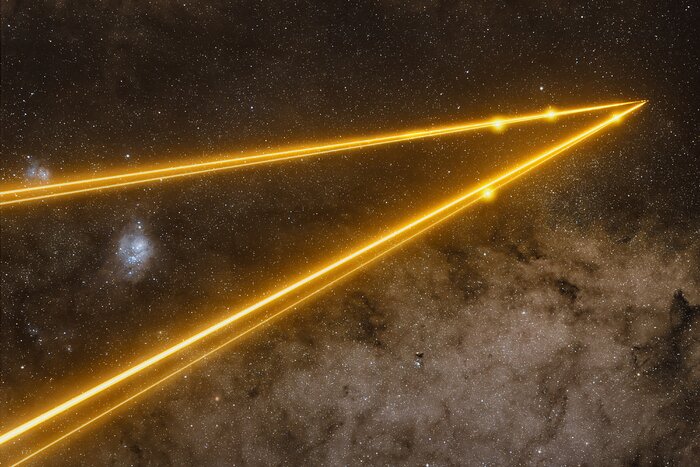
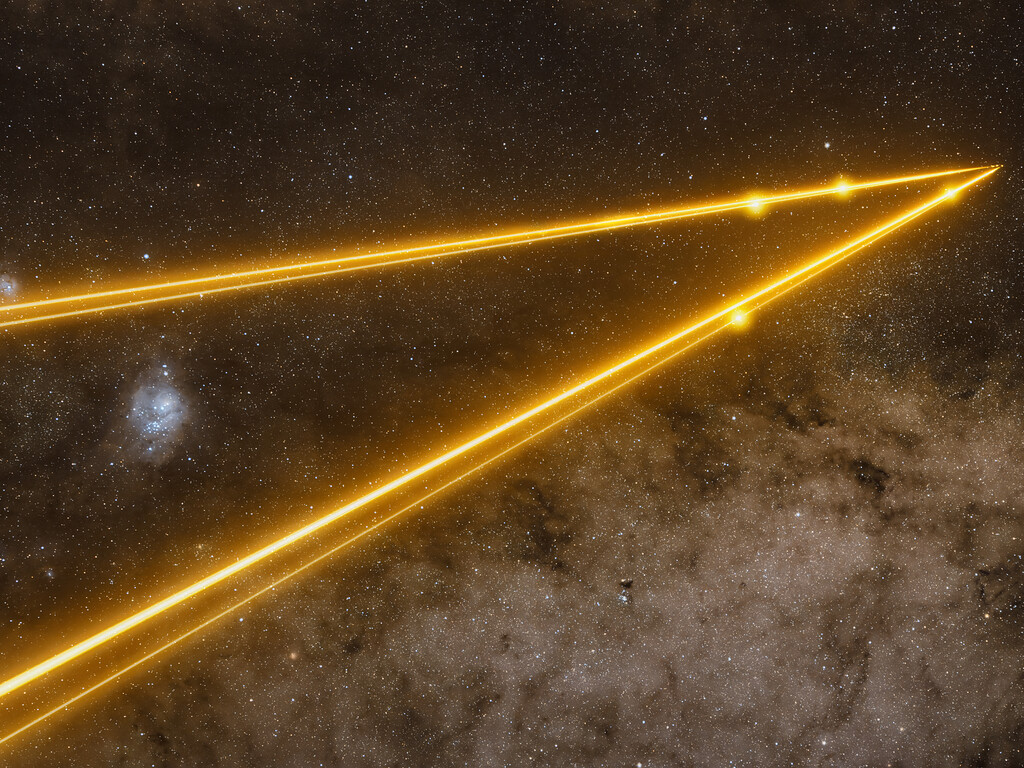
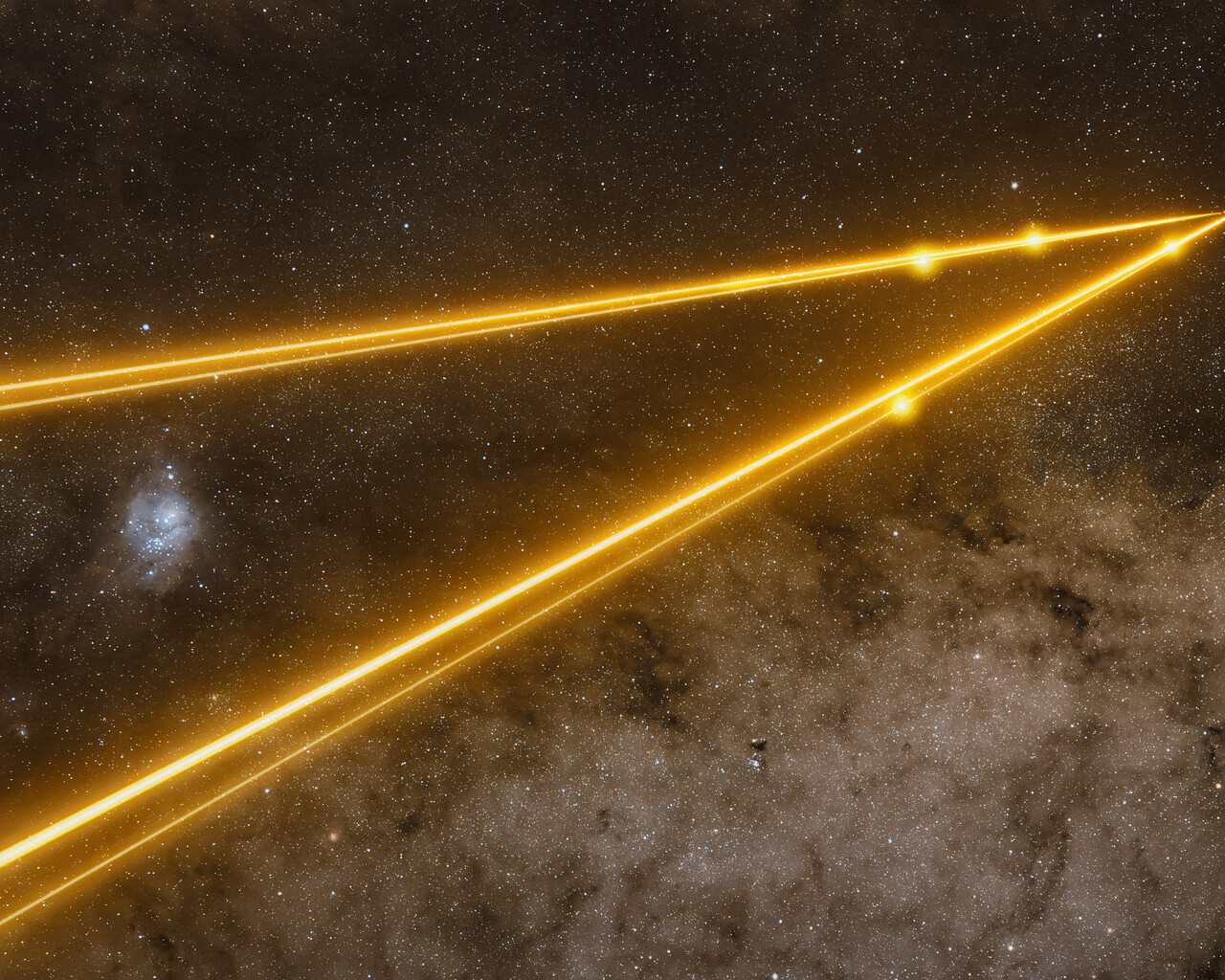
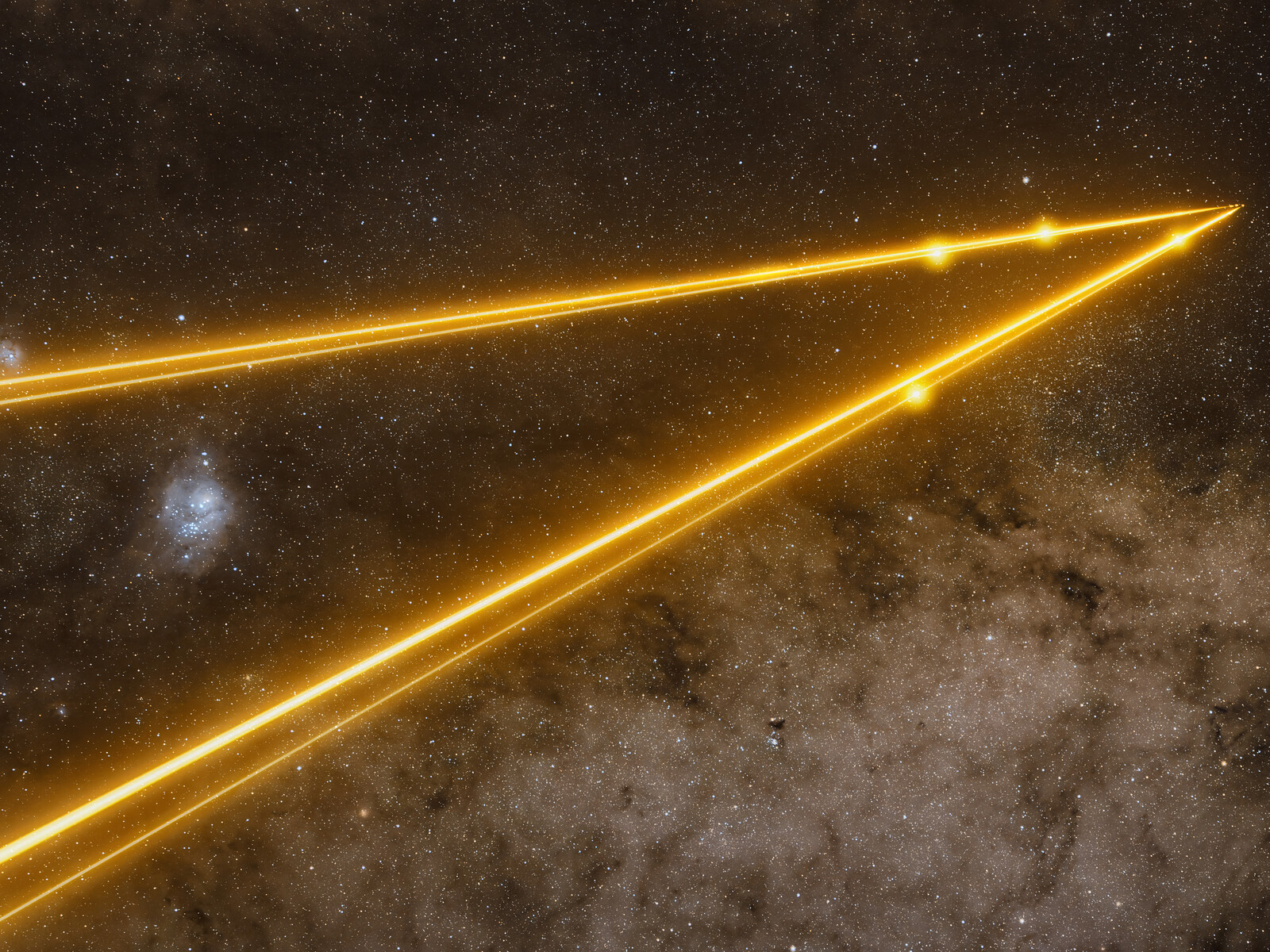
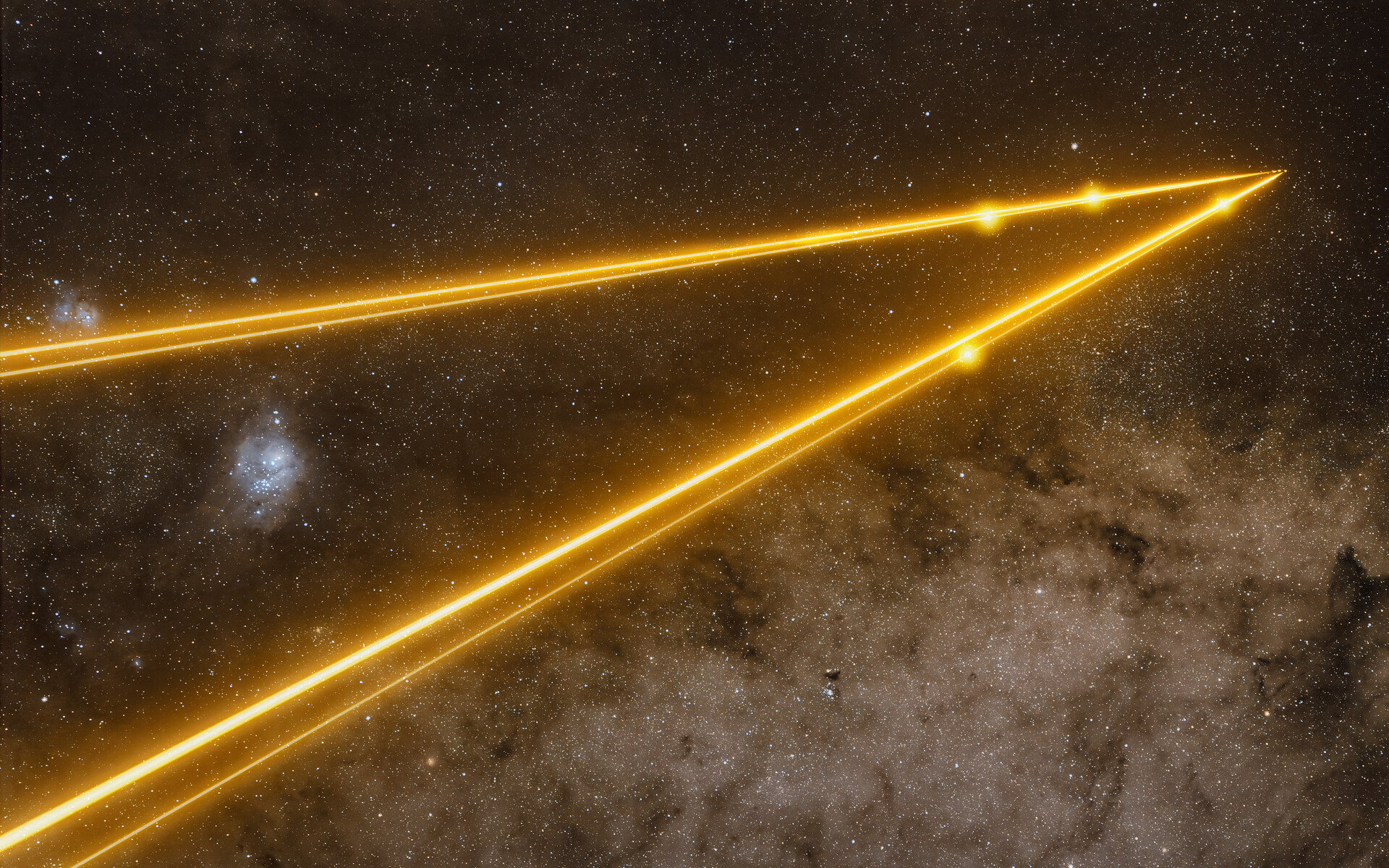
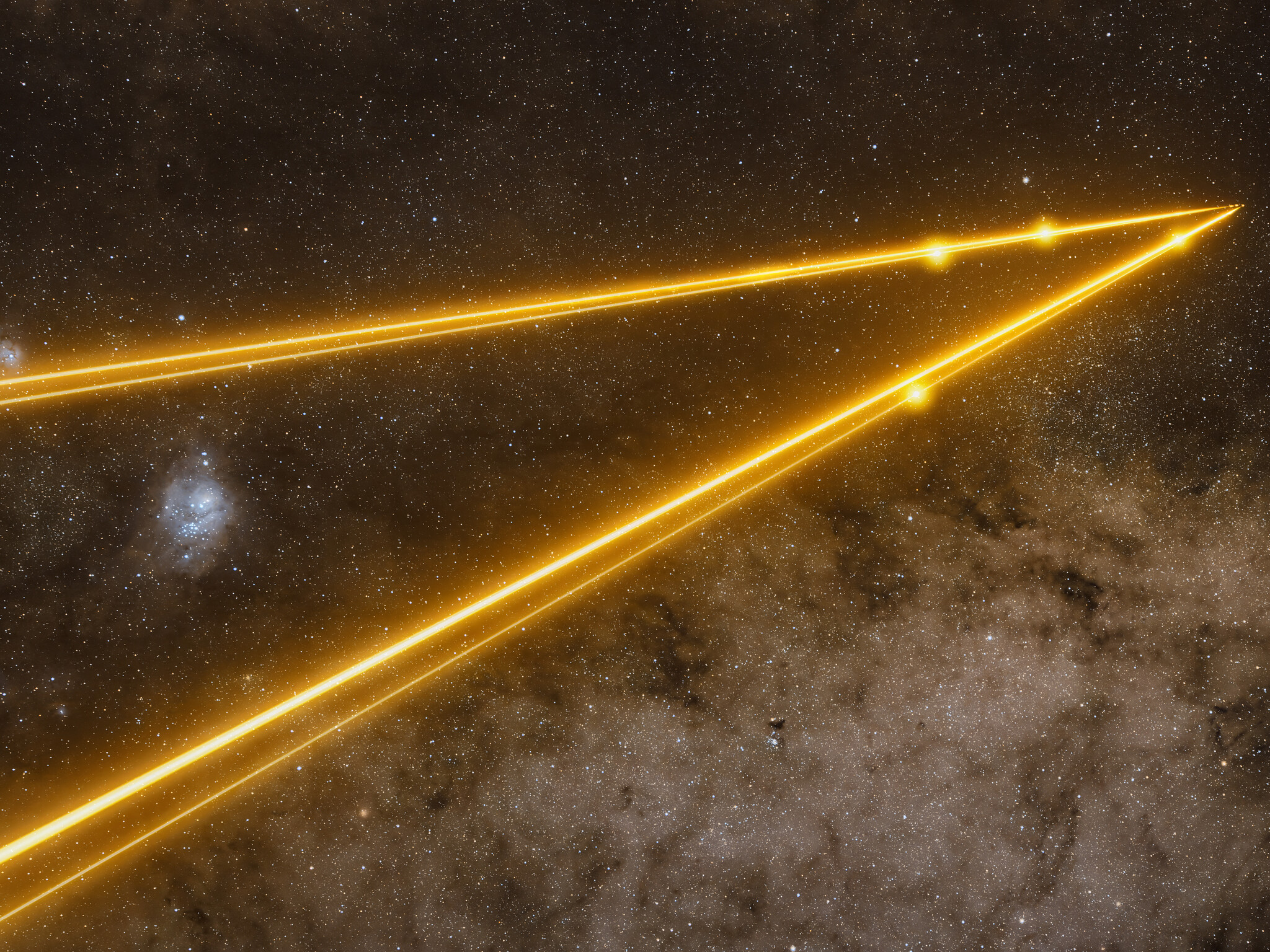
Heute richtet sich das Bild der Woche auf vier Laserstrahlen, die über den eindrucksvollen Südhimmel leuchten. Auf jedem Strahl ist ein heller Lichtpunkt zu sehen. Diese leuchtenden Punkte entstehen, weil eine dünne Wolkenschicht die Laserstrahlen kreuzt, und verraten zugleich, woher die Strahlen kommen. Sie werden von den vier Hauptteleskopen des Very Large Telescope der ESO ausgesendet, die hier gemeinsam als Teil des VLT-Interferometers arbeiten. Die Anordnung der vier hellen Punkte entspricht der Anordnung dieser vier Hauptteleskope. Die Punkte selbst waren allerdings ein glücklicher Zufall: Sie entstanden durch Wolken, die gerade im Weg lagen. Die Laserstrahlen zielen eigentlich auf eine deutlich höhere Schicht unserer Atmosphäre.
Seit November 2025 sind alle vier Hauptteleskope mit Lasern ausgestattet. Sie gehören zu einer Reihe wichtiger Verbesserungen am VLT-Interferometer unter dem Namen GRAVITY+. Jeder Laser erzeugt 90 Kilometer über der Erdoberfläche einen künstlichen „Stern“. Mit dessen Hilfe lässt sich messen, wie die turbulente Atmosphäre das Licht aus dem All verzerrt. So kann ein Teleskop diese Störungen in Echtzeit ausgleichen und die Unschärfe durch die Atmosphäre weitgehend aufheben. Das so geschärfte Licht der vier Hauptteleskope kann anschließend zusammengeführt werden, um ferne Himmelsobjekte besonders detailliert zu beobachten. Durch dieses Upgrade kann das VLT-Interferometer nun den gesamten Südhimmel erschließen und deutlich lichtschwächere Objekte untersuchen als zuvor.
Auf diesem Bild zeigen die Teleskope und ihre Laser auf das Zentrum unserer Galaxis, also auf die Region um das supermassereiche Schwarze Loch Sagittarius A*. Wer genau an die Spitze des von den Lasern gebildeten Dreiecks schaut, kann vielleicht die vier winzigen künstlichen Sterne erkennen, die von den Strahlen erzeugt werden. Genauere Beobachtungen im Herzen der Milchstraße sind ein wichtiges wissenschaftliches Ziel von GRAVITY+. Sie sollen vor allem helfen, die Eigenschaften unseres zentralen Schwarzen Lochs besser zu verstehen.
„Für mich ist dieses Bild ein Erfolg“, kommeniert ESO-Astronom und Fotograf Anthony Berdeu, der seit 2022 am Projekt GRAVITY+ arbeitet. Es seien intensive, anspruchsvolle, aber auch faszinierende Jahre gewesen, in denen er mit großartigen und sehr talentierten Menschen im Konsortium und bei der ESO zusammenarbeiten konnte. Nach Jahren harter Arbeit an den Verbesserungen, so sagt er, musste er in der ersten Nacht, in der die Laser auf das galaktische Zentrum gerichtet wurden, unbedingt auf der VLT-Plattform sein, um ein Foto zu machen.
Seine Aufnahme zeigt nicht nur die vier Laser, die scheinbar die dunkle Stelle durchbohren, an der kosmische Staubwolken das galaktische Zentrum verdecken. Zu sehen sind auch das helle Band der Milchstraße unten rechts sowie links der Lagunennebel und der Trifidnebel, die beide etwa 5000 Lichtjahre entfernt sind. Außerdem erlebte Berdeu eine „schöne Überraschung“, als eine dünne vorbeiziehende Wolke die Laserstrahlen kreuzte und die Anordnung der Hauptteleskope als goldene Punkte sichtbar machte. Das, sagt er, habe der Szene noch zusätzliche Wirkung verliehen.
Links
- Version des Bildes mit eingezeichneter Anordnung der Teleskope
- Zeitraffervideo der Laserstrahlen zwischen den Wolken
A. Berdeu/ESO
Über das Bild
| ID: | potw2621a |
| Sprache: | de-ch |
| Typ: | Fotografisch |
| Veröffentlichungsdatum: | 25. Mai 2026 06:00 |
| Größe: | 6864 x 4576 px |
Über das Objekt
| Name: | Laser Guide Star, Very Large Telescope, Very Large Telescope Interferometer, VLT Unit Telescopes |
| Typ: | Unspecified : Technology : Observatory |
Bildformate


Our use of Cookies
We use cookies that are essential for accessing our websites and using our services. We also use cookies to analyse, measure and improve our websites’ performance, to enable content sharing via social media and to display media content hosted on third-party platforms.
ESO Cookies Policy
The European Organisation for Astronomical Research in the Southern Hemisphere (ESO) is the pre-eminent intergovernmental science and technology organisation in astronomy. It carries out an ambitious programme focused on the design, construction and operation of powerful ground-based observing facilities for astronomy.
This Cookies Policy is intended to provide clarity by outlining the cookies used on the ESO public websites, their functions, the options you have for controlling them, and the ways you can contact us for additional details.
What are cookies?
Cookies are small pieces of data stored on your device by websites you visit. They serve various purposes, such as remembering login credentials and preferences and enhance your browsing experience.
Categories of cookies we use
Essential cookies (always active): These cookies are strictly necessary for the proper functioning of our website. Without these cookies, the website cannot operate correctly, and certain services, such as logging in or accessing secure areas, may not be available; because they are essential for the website’s operation, they cannot be disabled.
Functional Cookies: These cookies enhance your browsing experience by enabling additional features and personalization, such as remembering your preferences and settings. While not strictly necessary for the website to function, they improve usability and convenience; these cookies are only placed if you provide your consent.
Analytics cookies: These cookies collect information about how visitors interact with our website, such as which pages are visited most often and how users navigate the site. This data helps us improve website performance, optimize content, and enhance the user experience; these cookies are only placed if you provide your consent. We use the following analytics cookies.
Matomo Cookies:
This website uses Matomo (formerly Piwik), an open source software which enables the statistical analysis of website visits. Matomo uses cookies (text files) which are saved on your computer and which allow us to analyze how you use our website. The website user information generated by the cookies will only be saved on the servers of our IT Department. We use this information to analyze www.eso.org visits and to prepare reports on website activities. These data will not be disclosed to third parties.
On behalf of ESO, Matomo will use this information for the purpose of evaluating your use of the website, compiling reports on website activity and providing other services relating to website activity and internet usage.
Matomo cookies settings:
Additional Third-party cookies on ESO websites: some of our pages display content from external providers, e.g. YouTube.
Such third-party services are outside of ESO control and may, at any time, change their terms of service, use of cookies, etc.
YouTube: Some videos on the ESO website are embedded from ESO’s official YouTube channel. We have enabled YouTube’s privacy-enhanced mode, meaning that no cookies are set unless the user actively clicks on the video to play it. Additionally, in this mode, YouTube does not store any personally identifiable cookie data for embedded video playbacks. For more details, please refer to YouTube’s embedding videos information page.
Cookies can also be classified based on the following elements.
Regarding the domain, there are:
- First-party cookies, set by the website you are currently visiting. They are stored by the same domain that you are browsing and are used to enhance your experience on that site;
- Third-party cookies, set by a domain other than the one you are currently visiting.
As for their duration, cookies can be:
- Browser-session cookies, which are deleted when the user closes the browser;
- Stored cookies, which stay on the user's device for a predetermined period of time.
How to manage cookies
Cookie settings: You can modify your cookie choices for the ESO webpages at any time by clicking on the link Cookie settings at the bottom of any page.
In your browser: If you wish to delete cookies or instruct your browser to delete or block cookies by default, please visit the help pages of your browser:
Please be aware that if you delete or decline cookies, certain functionalities of our website may be not be available and your browsing experience may be affected.
You can set most browsers to prevent any cookies being placed on your device, but you may then have to manually adjust some preferences every time you visit a site/page. And some services and functionalities may not work properly at all (e.g. profile logging-in, shop check out).
Updates to the ESO Cookies Policy
The ESO Cookies Policy may be subject to future updates, which will be made available on this page.
Additional information
For any queries related to cookies, please contact: pdprATesoDOTorg.
As ESO public webpages are managed by our Department of Communication, your questions will be dealt with the support of the said Department.