Mededeling
BlueMUSE: ESO tekent overeenkomst voor nieuw instrument op de VLT
30 januari 2026
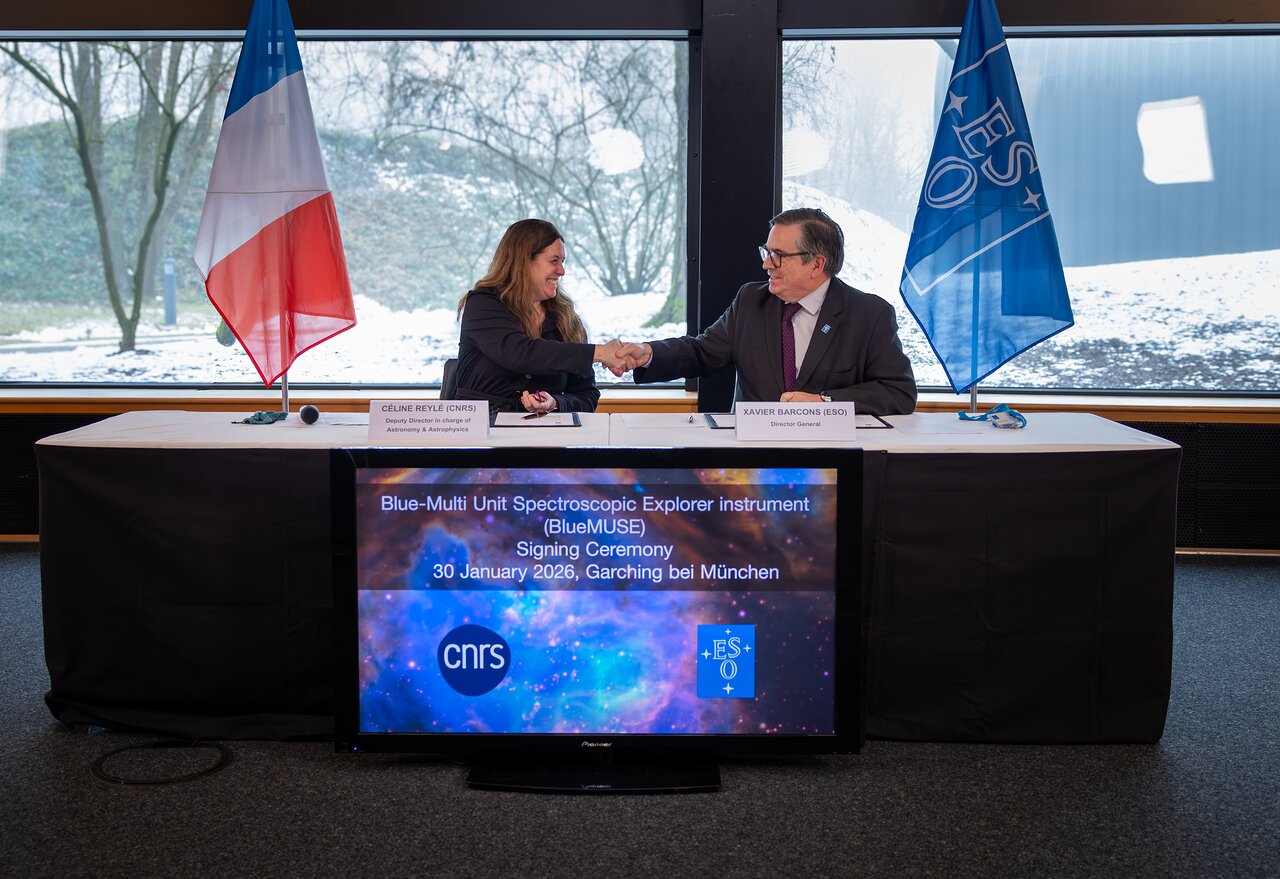
Vandaag heeft ESO de overeenkomst ondertekend voor de bouw van de Blue Multi Unit Spectroscopic Explorer (BlueMUSE), een nieuw instrument voor ESO’s Very Large Telescope (VLT). Met de ondertekening is de eerste belangrijke stap gezet in de ontwikkeling van BlueMUSE, die astronomen nieuwe en unieke wetenschappelijke mogelijkheden zal bieden. De geavanceerde technologie maakt detailrijke waarnemingen mogelijk van uiteenlopende objecten binnen ons Melkwegstelsel, van zware sterren tot nevels en kometen. Het zal ook een revolutie teweegbrengen in het onderzoek van het verre heelal via de detectie van diffuus materiaal in de ruimte tussen melkwegstelsels, en inzicht geven in de bewegingen van de daarin aanwezige materie.
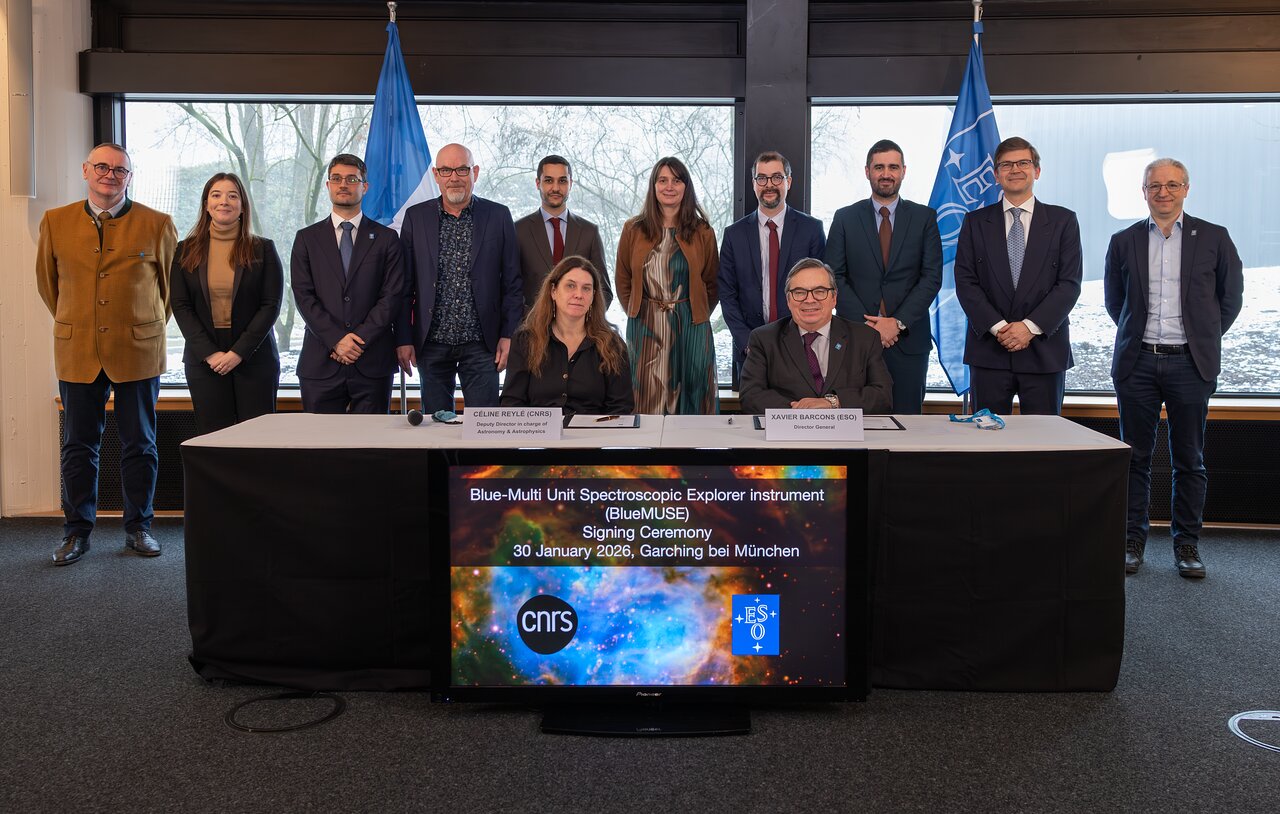
Eerder vandaag hebben Xavier Barcons, directeur-generaal van ESO, en Céline Reylé, adjunct-directeur voor astronomie en astrofysica bij het Franse nationale centrum voor wetenschappelijk onderzoek (CNRS), de BlueMUSE-overeenkomst ondertekend op het hoofdkantoor van ESO in Garching, Duitsland. De leiding van het instrumentenconsortium is in handen van het Centre de Recherche Astrophysique de Lyon (CRAL – CNRS/ENS de Lyon/Claude Bernard Lyon 1 University) van het CNRS, dat uit meerdere instituten in Europa en Australië bestaat. Ook aanwezig bij de viering van de volgende fase van het instrument waren de Franse wetenschappelijk attaché voor Zuid-Duitsland, Emmanuel Delille, de hoofdonderzoeker van BlueMUSE, Johan Richard, en de projectmanager Rémi Giroud, beiden van CRAL, evenals andere hoogwaardigheidsbekleders van ESO en het BlueMUSE-consortium [1].
BlueMUSE is een integraalveldspectrograaf, gebaseerd op de succesvolle technologie van het MUSE-instrument dat op de VLT is geïnstalleerd. Hij is ontworpen om niet alleen een tweedimensionaal beeld van een object (of meerdere objecten) vast te leggen, maar ook om het licht van elke pixel op te splitsen in zijn samenstellende kleuren of golflengten, wat resulteert in een volledige driedimensionale dataset die uitgebreide informatie geeft over het waargenomen object. Aangezien MUSE een van de meest productieve en gevraagde ESO-instrumenten is geworden, hoopte de astronomische gemeenschap al enige tijd op vergelijkbaar instrument, en aan die vraag wordt nu tegemoetgekomen.
Hoewel BlueMUSE in veel opzichten op MUSE lijkt, zal het instrument waarnemingen doen op kortere en dus blauwere golflengten, en met een hogere spectrale resolutie (een maat die aangeeft hoe fijn onderscheid kan worden gemaakt tussen verschillende golflengten). Dit betekent dat het een belangrijke aanvulling zal zijn op grote faciliteiten op de grond en in de ruimte, zoals de toekomstige Extremely Large Telescope van ESO en de James Webb-ruimtetelescoop, die zijn geoptimaliseerd voor waarnemingen in het infrarood.
BlueMUSE, die naar verwachting in 2034 in gebruik wordt genomen, zal wetenschappelijke mogelijkheden bieden die verder gaan dan wat met MUSE mogelijk is. Hij zal grotere steekproeven van zware sterren in de Melkweg en haar galactische omgeving onderzoeken, wat zal helpen bij het beantwoorden van belangrijke vragen over de evolutie van sterren. Daarnaast zal het instrument in staat zijn om zwakke sterrenstelsels en starburst-sterrenstelsels en hun extreme stervormingsomgeving te onderzoeken. Ook zal BlueMUSE bij uitstek geschikt zijn om het verre heelal, en met name de zeer diffuse, ongrijpbare materie in de ruimte tussen de sterrenstelsels en het ontstaan van de eerste clusters van sterrenstelsels te bestuderen.
Noten
[1] De ondertekeningsceremonie werd bijgewoond door Karine Perraut (Franse ESO-raadsafgevaardigde, van het Institut National des Sciences de l’Univers (INSU), CNRS Earth & Space, Frankrijk), Florence Laurent (BlueMUSE-systeemingenieur bij CNRS), Davor Krajnović (BlueMUSE-projectwetenschapper, Leibniz-Institut für Astrophysik Potsdam, Duitsland), Alexandre Jeanneau (BlueMUSE Hoofd Optisch Ingenieur bij CNRS).
Namens ESO waren naast Xavier Barcons ook Frédéric Derie (projectmanager), Francesco Belfiore (projectwetenschapper), Reinhold Dorn (projectingenieur), Michele Cirasuolo (instrumentatieprogrammamanager), Suzanne Ramsay (adjunct-instrumentatieprogrammamanager), Céline Péroux (programmaleider), Andrea Capardi (programmacoördinator), Enrico Marchetti (instrumentatieprogramma-ingenieur), Emanuela Ciattaglia (instrumentatieprogramma-ingenieur), Diogo Rio Fernandes (instrumentatieprogramma-ingenieur), Alain Delorme (waarnemend hoofd contracten & inkoop) en Cyrielle Blanc (contract- en inkoopmedewerker) aanwezig.
Meer informatie
Het BlueMUSE-project zal worden uitgevoerd door een internationaal consortium, bestaande uit negen onderzoeksinstituten in verschillende landen en ESO. Het consortium bestaat uit
- Australië: Australian Astronomical Optics; Macquarie University
- Frankrijk: Centre de Recherche Astrophysique de Lyon (CRAL - CNRS/ENS de Lyon/Claude Bernard Lyon 1 University; projectleiding); Astrophysique, Instrumentation & Modélisation (AIM – CEA/CNRS/ Université Paris Cité); Institut de Recherche sur les lois Fondamentales de l’Univers (CEA/Saclay)
- Duitsland: Leibniz Institute for Astrophysics Potsdam (AIP) in samenwerking met de Universiteit van Potsdam en de Universiteit van Göttingen
- Portugal: Instituut voor Astrofysica en Ruimtewetenschappen
- Zweden: Vakgroep Astronomie, Universiteit van Stockholm
- Zwitserland: Sterrenwacht van de Universiteit van Genève; Laboratorium voor Astrofysica, Technische Universiteit van Lausanne (EPFL)
- Verenigd Koninkrijk: Centrum voor Geavanceerde Instrumentatie en Centrum voor Extragalactische Astronomie, Faculteit Natuurkunde, Universiteit van Durham
Ook ESO draagt bij aan de ontwikkeling van het project.
Links
Over de Mededeling
| Id: | ann26001 |
Afbeeldingen


Our use of Cookies
We use cookies that are essential for accessing our websites and using our services. We also use cookies to analyse, measure and improve our websites’ performance, to enable content sharing via social media and to display media content hosted on third-party platforms.
ESO Cookies Policy
The European Organisation for Astronomical Research in the Southern Hemisphere (ESO) is the pre-eminent intergovernmental science and technology organisation in astronomy. It carries out an ambitious programme focused on the design, construction and operation of powerful ground-based observing facilities for astronomy.
This Cookies Policy is intended to provide clarity by outlining the cookies used on the ESO public websites, their functions, the options you have for controlling them, and the ways you can contact us for additional details.
What are cookies?
Cookies are small pieces of data stored on your device by websites you visit. They serve various purposes, such as remembering login credentials and preferences and enhance your browsing experience.
Categories of cookies we use
Essential cookies (always active): These cookies are strictly necessary for the proper functioning of our website. Without these cookies, the website cannot operate correctly, and certain services, such as logging in or accessing secure areas, may not be available; because they are essential for the website’s operation, they cannot be disabled.
Functional Cookies: These cookies enhance your browsing experience by enabling additional features and personalization, such as remembering your preferences and settings. While not strictly necessary for the website to function, they improve usability and convenience; these cookies are only placed if you provide your consent.
Analytics cookies: These cookies collect information about how visitors interact with our website, such as which pages are visited most often and how users navigate the site. This data helps us improve website performance, optimize content, and enhance the user experience; these cookies are only placed if you provide your consent. We use the following analytics cookies.
Matomo Cookies:
This website uses Matomo (formerly Piwik), an open source software which enables the statistical analysis of website visits. Matomo uses cookies (text files) which are saved on your computer and which allow us to analyze how you use our website. The website user information generated by the cookies will only be saved on the servers of our IT Department. We use this information to analyze www.eso.org visits and to prepare reports on website activities. These data will not be disclosed to third parties.
On behalf of ESO, Matomo will use this information for the purpose of evaluating your use of the website, compiling reports on website activity and providing other services relating to website activity and internet usage.
Matomo cookies settings:
Additional Third-party cookies on ESO websites: some of our pages display content from external providers, e.g. YouTube.
Such third-party services are outside of ESO control and may, at any time, change their terms of service, use of cookies, etc.
YouTube: Some videos on the ESO website are embedded from ESO’s official YouTube channel. We have enabled YouTube’s privacy-enhanced mode, meaning that no cookies are set unless the user actively clicks on the video to play it. Additionally, in this mode, YouTube does not store any personally identifiable cookie data for embedded video playbacks. For more details, please refer to YouTube’s embedding videos information page.
Cookies can also be classified based on the following elements.
Regarding the domain, there are:
- First-party cookies, set by the website you are currently visiting. They are stored by the same domain that you are browsing and are used to enhance your experience on that site;
- Third-party cookies, set by a domain other than the one you are currently visiting.
As for their duration, cookies can be:
- Browser-session cookies, which are deleted when the user closes the browser;
- Stored cookies, which stay on the user's device for a predetermined period of time.
How to manage cookies
Cookie settings: You can modify your cookie choices for the ESO webpages at any time by clicking on the link Cookie settings at the bottom of any page.
In your browser: If you wish to delete cookies or instruct your browser to delete or block cookies by default, please visit the help pages of your browser:
Please be aware that if you delete or decline cookies, certain functionalities of our website may be not be available and your browsing experience may be affected.
You can set most browsers to prevent any cookies being placed on your device, but you may then have to manually adjust some preferences every time you visit a site/page. And some services and functionalities may not work properly at all (e.g. profile logging-in, shop check out).
Updates to the ESO Cookies Policy
The ESO Cookies Policy may be subject to future updates, which will be made available on this page.
Additional information
For any queries related to cookies, please contact: pdprATesoDOTorg.
As ESO public webpages are managed by our Department of Communication, your questions will be dealt with the support of the said Department.