Welcome to the European ALMA Regional Centre Newsletter!
This monthly newsletter is a compilation of recent European ALMA Regional Centre news and announcements, showcasing an exciting ALMA science result by European colleagues. Every month, you can learn an interesting ALMA fact in "Did you know" and give your opinion about a particular ALMA matter in the "Poll of the month".
On 13 April 2026, ESO held the kick-off meeting for the Feasibility Study for a new generation of European ALMA receivers covering the 125–211 GHz band (ESO-654032) at the INAF-OAS premises in Bologna, Italy. The meeting marked the formal start of a two-year study to explore the technical and scientific feasibility of a combined ALMA Band 4+5 receiver system covering the 125–211 GHz frequency range. This ALMA development study is relevant for the later stages of the Wideband Sensitivity Upgrade (WSU) programme.
The 13th IRAM Interferometry School will be held at the Hotel Mercure Grenoble Centre Porte des Alpes in Grenoble, France, from 28 September to 3 October, 2026. It is intended for PhD students, postdocs and scientists who want to learn about interferometry and data reduction techniques at millimeter wavelengths, centred on the NOEMA interferometer and its new capabilities.
The program will include lectures on the fundamentals of millimeter interferometry, atmospheric and instrumental calibration and imaging techniques (including short spacing and mosaic), as well as practical tutorials on interferometric data reduction and proposal writing. A visit to the NOEMA Observatory will also be organised on 3 Oct (weather dependent).
The Square Kilometre Array Observatory is inviting applications for a Postdoctoral Researcher in Machine Learning for Radio Interferometry at its global headquarters near Manchester.
The successful researcher will join an international collaboration in support of an ESO/SKAO-funded project aimed at developing deep-learning-based image reconstruction techniques for radio interferometry. The project will be based on ALMA data, with the goal of extending the developed algorithms for future applications with SKA telescopes.
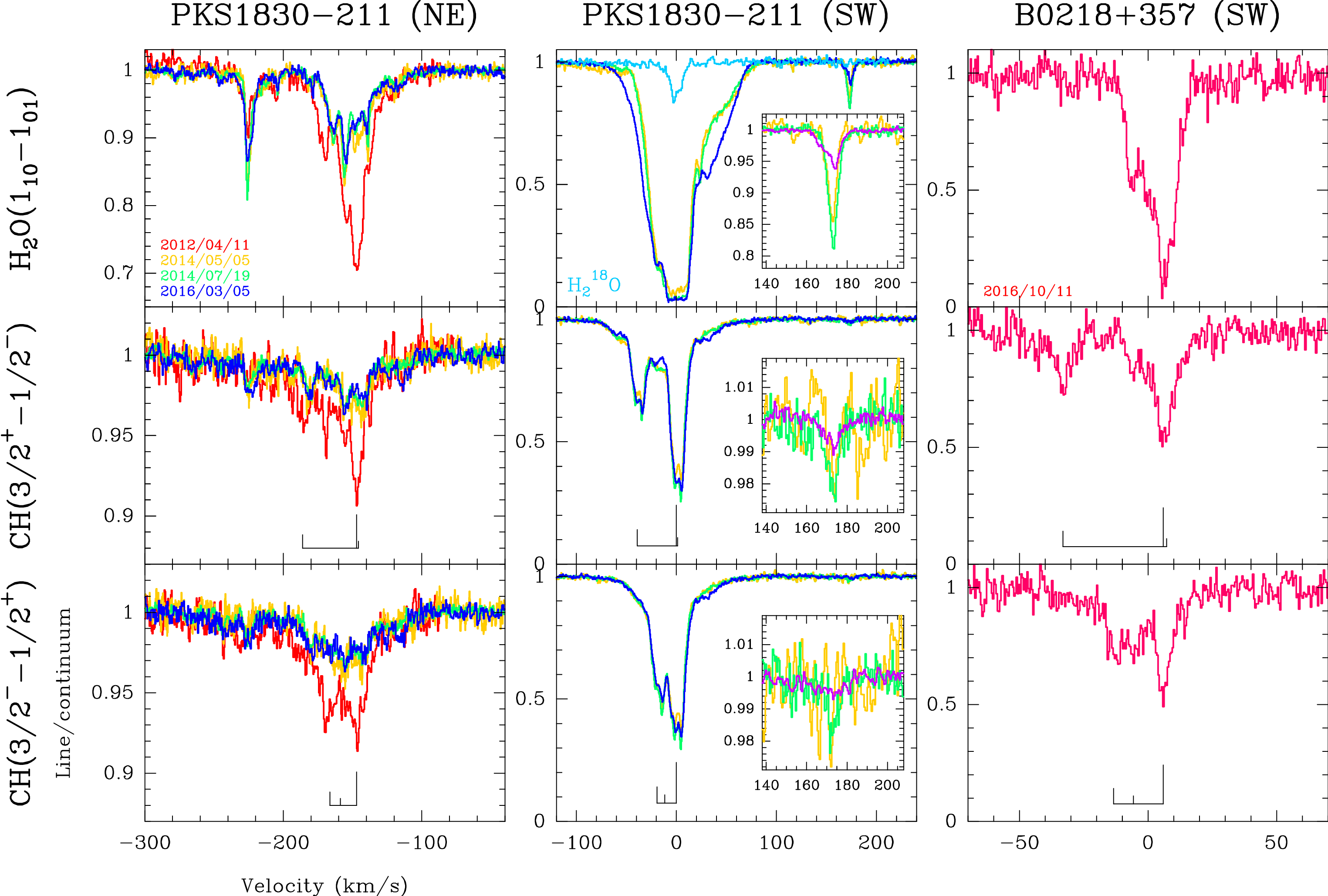
A sub-ppm upper limit on the cosmological variations of the fine structure constant alpha
Absorption spectra of CH and H2O observed by ALMA toward the bright, strongly lensed quasars PKS1830-211 and B0218+357
Several 'magic' constants of nature emerge from our theoretical description of the world. However, no current theory is capable of predicting their values and, in fact, many theories predict that they are not necessarily constant in time or space. In a recent study published in A&A, Muller et al. used ALMA observations of two molecules: CH and H2O, observed in absorption in two distant galaxies (at a look-back time of about half the present age of the Universe) against the bright quasars PKS1830-211 and B0218+357, to conclude that one such fundamental constant of nature, the fine-structure constant alpha that quantifies the strength of the electromagnetic interaction between elementary charged particles, does not change by more than 1 part-per-million compared to its value, here and now, on Earth.
The limit inferred by Muller et al. on cosmological variation of alpha is the most stringent obtained so far (an improvement by at least a factor 2) with other techniques. Their measurement uses fine-structure and rotational transitions of molecules, in the submillimeter domain. Previous such studies are traditionally done with optical telescopes, observing multiple atomic lines, and averaging data over tens or more sources. This approach is then complementary to optical studies, and somehow 'cleaner' in the radio, since we have different known systematic effects, that we have been thoroughly controlling and minimizing.
If you have any suggestions or complaints about the web-based OT, please make a Helpdesk ticket
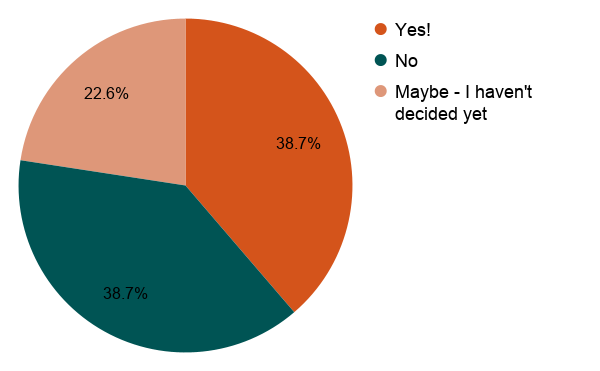
Results from last month's poll, "Will you be proposing Band 2 observations this cycle?"
Did you know?
The European ARC Network organizes I-TRAIN, a regular series of Interactive Training in Reduction and Analysis of INterferometric data. The sessions aim to help ALMA users gain expertise in working with interferometric data, such as self-calibration, u-v model fitting, and data combination. You can view previous I-TRAIN sessions here.
If you would like to contribute an ALMA science highlight, please contact the newsletter editor at Hannah.Stacey@eso.org.