Welcome to the European ALMA Regional Centre Newsletter!
This monthly newsletter is a compilation of recent European ALMA Regional Centre news and announcements, showcasing an exciting ALMA science result by European colleagues. Every month, you can learn an interesting ALMA fact in "Did you know" and give your opinion about a particular ALMA matter in the "Poll of the month".
New information for ALMA Principal Investigators (PIs) in Cycle 13: Starting with Cycle 13, Phase 2 information for approved programs will be shown to PIs through the Snooping Project Interface (SnooPI) after the Scheduling Blocks (SBs) have been created. SnooPI now provides field and spectral information for every science target in each SB (e.g., target coordinates and radial velocities, spectral window frequencies, and correlator setups). Additionally, spatial and spectral visualizers to facilitate displaying this information will also be available in SnooPI after 29 September, 2026. These capabilities are similar to what was previously provided through the Phase 2 Observing Tool (OT). More detailed information can be found in the SnooPI User Manual.
As a consequence, ALMA will no longer provide a Phase 2 version of the OT and PIs will need to check SB information through SnooPI.
ALMA has analysed the refereed ALMA publications in the period from 2012 to 2024. The study analyses publication statistics related to various aspects, e.g., science categories, geographical distribution, archival research, time to publication, publication fraction, and citations. Among other results, the analysis shows that about 70% of observed projects were used in at least one publication, and ALMA publications so far were written by more than 9400 unique authors. The median time to first publication since data delivery is 2.1 years, and about 40% of publications made use of archival data in 2024.
The publication evolution follows that of other high impact observatories as the Hubble Space Telescope and Very Large Telescope. In 2024, the impact factor for ALMA publications, defined as the total number of citations received in a given year stemming from publications of the previous two years, is larger than that of all other major astronomical facilities. Links to the full publication (Stoehr et al. 2026, PASP) can be found here.
"ALMA at 15 Years: Science, Synergies, and the Road Ahead" will be held in person from Feb. 22–26, 2027, at Academia Sinica's Nangang campus in Taipei, Taiwan. The abstract submission deadline is 15 September. You can register at this link.
IRAM is an international research organisation for millimetre and submillimetre astronomy that operates two world-class research facilities: the IRAM 30-m telescope in Spain, and NOEMA, the largest millimetre interferometer of the northern hemisphere, in the French Alps. The institute houses one of the nodes of the European ALMA science support centre.
IRAM is offering 2+ year postdoctoral positions within the NOEMA Science Operations Group (SOG) based at IRAM headquarters (Grenoble). The closing date for applications is 8 November, 2026. You can learn more about the job offer here.
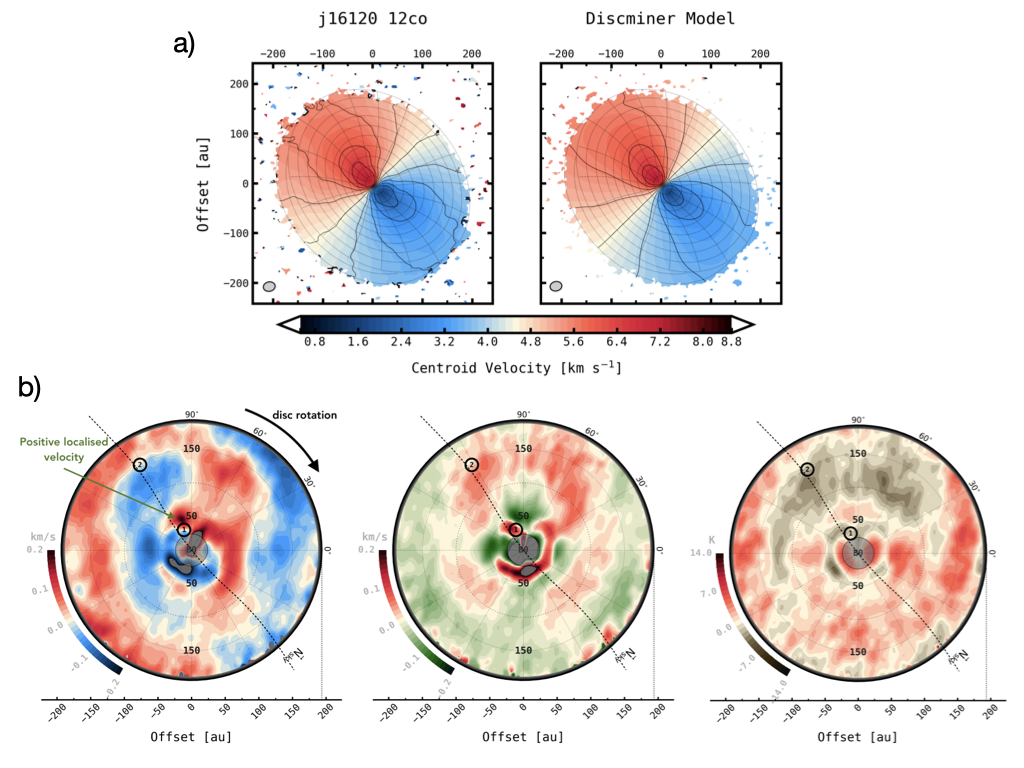
Morphological and kinematic substructures driven by a forming planet
a) Kinematics of the 12CO emission around J16120. Left: Peak velocity along the line of sight. Right: Discminer model.
b) De-projected residual maps after subtracting the best fit discminer model. Left: disc velocity residuals. Middle: line width residuals. Right: peak intensity residuals. The position of the inner planet candidate at r=32 au is marked by "1", while that of the outer planet candidate at r=148 au is marked by "2". The forming planet "1" coincides with a peak in velocity residuals (highlighted by the green arrow).
Planets form in protoplanetary discs. However, they are difficult to detect because they are embedded and often obscured by optically thick dust and gas, and may be confused with other disc sub-structures.
A new paper by Sierra et al. presents new ALMA Band 7 (0.87 mm) observations of the protoplanetary disc around J16120, a young M-type star hosting a previously proposed forming planet within its dust gap. The dust continuum reveals an inner disc and two rings at 23 and 75 au. The authors find the disc morphology is better fit by a slightly eccentric model (e ~ 0.1) which may arise from a planet with mass >2.2 Jupiter masses embedded in the gap.
The strongest new evidence comes from the gas kinematics. Modeling of 12CO and 13CO channel maps show kinematic sub-structures at the location of the 32 au planet candidate and along its orbital path. The velocity residual map also shows a spiral wake-like pattern with a transition from sub- to super-Keplerian rotation, plus tentative signs of gas flowing radially inward toward the candidate's orbit. A separate outer disc feature at 125–171 au, previously flagged as a possible second planet, does not show these features. Altogether, combined with earlier infrared and H-alpha detections from other studies, the authors argue J16120 is one of the strongest candidates for an embedded, actively forming planet, alongside the confirmed systems PDS 70 and WISPIT 2.
that you can contact the ESO Education and Public Outreach department (press@eso.org) if you have impactful results that you would like to share with the public? They will help you to identify the potential news value of your results and coordinate potential press releases to publicise them.
If you would like to contribute an ALMA science highlight, please contact the newsletter editor at Hannah.Stacey@eso.org.