Welcome to the European ALMA Regional Centre Newsletter!
This monthly newsletter is a compilation of recent European ALMA Regional Centre news and announcements, showcasing an exciting ALMA science result by European colleagues. Every month, you can learn an interesting ALMA fact in "Did you know" and give your opinion about a particular ALMA matter in the "Poll of the month".
On 16 June 2026, ESO's ALMA Support Centre hosted the ALMA Band 2 Production Completion Event. 36 participants from the Band 2 consortium, contributing European institutes, industry partners, and the National Astronomical Observatory of Japan (NAOJ) travelled to ESO Garching to celebrate this important milestone for ALMA. Together with ESO staff, more than 70 people attended the associated workshop and celebration activities throughout the day.
Advanced data products (ADPs) are becoming increasingly important at modern radio observatories, helping transform complex observational datasets into more accessible, science-ready resources. Products such as enhanced images, spectral products, catalogs, or other higher-level derived datasets can reduce the effort required for scientific analysis and broaden access to archival data. To better understand how such products are currently used, and what additional capabilities may be most valuable to the community in the future, the Advanced Data Products Coordination Group (ADPCG), with members from various radio observatories and the broader community, is conducting a short survey on the usage and potential needs for advanced data products. We warmly encourage all members of the radio astronomy community to participate and share their perspective.
A detailed report of the Cycle 13 Proposal Submission Statistics is now available. The report provides a summary of items such as the number of submitted proposals and time requested, subscription rates, and comparisons with the number of hours requested in previous Cycles.
In Cycle 13, the number of proposals and requested time reached all-time highs. The European oversubscription rate also reached an all-time high of 10.2.
The ALMA Observatory has released data acquired in one of the Observatory Projects, 2024.A.00047.S. The data can be accessed through this link. ALMA Science Archive links for all the Observatory Projects can also be accessed from this main page for the Observatory Projects.
We are pleased to announce that the international conference "ALMA at 15 Years: Science, Synergies, and the Road Ahead" will be held in person from Feb. 22–26, 2027, at Academia Sinica's Nangang campus in Taipei, Taiwan. The conference will highlight ALMA's latest results, especially since the last Pan-ALMA conference held in 2023 and identify exciting directions for future ALMA research. Abstract submission is now open.
The program will feature invited and contributed science presentations, along with updates on the Wideband Sensitivity Upgrade (WSU), tutorial sessions on the archival and CARTA systems, and discussions of future ALMA prospects. Talks and posters presenting scientific work using ALMA and/or its synergies with other facilities across all areas of astronomy are welcome. Please visit the official conference website: https://2027alma.org
ALMA Band 10 observations uncover strongly absorbed [OI] 63µm lines at z>4
Overview of the Band 10 observations of SPT0418-47 at z=4.2. The central panel shows the continuum emission compared with Band 7 (white contours), forming an almost perfect Einstein ring. The top panel shows the non-detection of the integrated [OI] 63µm emission due to strong foreground emission, while the side panels show some emission in narrow “escape channels”.
Studies of the cold gas in the interstellar and circumgalactic medium of distant galaxies generally use atomic and molecular sub/mm lines in emission, such as CO, [CI], [CII] 158µm, or [OIII] 88µm. A hitherto barely used line is the [OI] 63µm fine structure line, which in nearby galaxies is as bright as [CII] and [OIII]. In a new study, the team used ALMA Band 10 and 9 to perform a first survey of [OI] 63µm from 12 gravitationally lensed dusty star-forming galaxies at 4<z<6.
Surprisingly, the [OI] 63µm was found to be 10 to 100 times fainter relative to [CII], which can only be explained by a significant amount of self-absorption by foreground clouds, causing the optically thick [OI] 63µm line to be seen in absorption. Only in some narrow (spatial and spectral) "escape channels" does the [OI] emission reach the observer, see e.g. the bottom right region D in the figure. Intriguingly, in several sources, the [OI] 63µm is instead seen in absorption against bright continuum sources, proving the foreground nature of the absorbing regions.
This result has several implications: First, for intrinsic line ratio studies, the optically thin 145µm [OI] line would be better suited than the 63µm line. Second, inspired by Galactic studies of the [CII] and [OI] lines, the densest foreground regions may also cause absorption in the widely used [CII] line. Third, the strong absorption by the foreground atomic gas could be used to determine the kinematics of this, thus far rarely studied, gas phase.
Overall, the results primarily obtained with Band 10 using the Band-to-Band calibration technique demonstrate that high-frequency observations are now rather standard observations, for which the authors could use the ALMA pipeline results. Further details can be found in the paper available here.
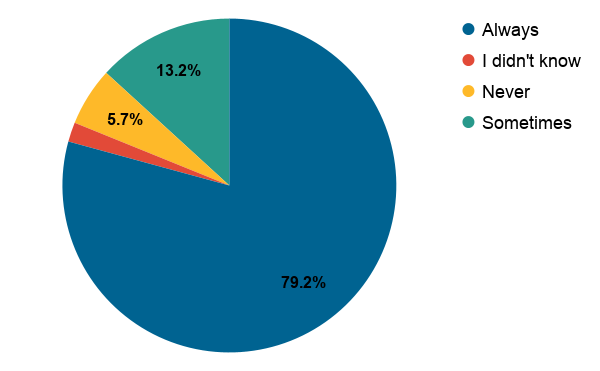
Results from last month's poll, "How often do you re-image data?"
If you would like help re-imaging data, please contact your local ARC Node.
Did you know?
that you can visit the European ARC nodes for in-person or remote face-to-face support which includes the help with proposal preparation, data reduction and archival research? You can request face-to-face support at your local ARC node via the "Face to Face Support (EU)" department of the ALMA Helpdesk.
If you would like to contribute an ALMA science highlight, please contact the newsletter editor at Hannah.Stacey@eso.org.