European ARC Newsletter
30 Jul 2025

Welcome to the European ALMA Regional Centre Newsletter!  

This monthly newsletter is a compilation of recent European ALMA Regional Centre news and announcements, showcasing an exciting ALMA science result by European colleagues. Every month, you can learn an interesting ALMA fact in "Did you know" and give your opinion about a particular ALMA matter in the "Poll of the month".


News and announcements Science highlight Poll of the month Did you know


European ARC News and Announcements


Major new ALMA Science Archive features

29 Jul 2026:

The ALMA Science Archive has received substantial feature upgrades, some of which have been worked on for years.

The ALMA Science Archive Query Interface now allows users to search for lines that have been detected by ADMiT in the public ALMA data products. Users can not only search for molecules and transitions, but redshifts and source velocities or line intensities. Previews are also included for the detected lines. The Request Handler download interface has also received an upgrade - it now shows the hierarchy of the data structure in a modern, intelligently scrollable way where the displayed information can be easily expanded and collapsed. A new powerful search bar at the top allows users to filter the displayed rows by text-, unix-pattern or regular-expression search. The output can be sorted, and a quick-select menu allows users to perform the most-used selections. 

Read more


ALMA reaches 5000 refereed publications

23 Jul 2026:

On June 27th, ALMA and its scientific community reached a major scientific milestone with the publication of the 5000th refereed paper based on ALMA data. This achievement comes just 14 years after the start of Early Science operations and reflects ALMA’s extraordinary scientific impact. All of these ALMA publications and data are accessible through the ALMA Science Archive at almascience.org/aq.

ALMA would like to thank and congratulate the many scientific teams and individuals who have made excellent use of ALMA observations in these publications to advance the understanding of our cosmic origins. The scientific impact of ALMA continues to grow. Publications based on ALMA data have accumulated more than 210,000 citations, establishing ALMA as one of the most productive and scientifically impactful astronomical facilities in the world.

Read more


Comparison of Panel Review and Distributed Peer Review at ALMA

23 Jul 2026:

Since 2021, ALMA has used a distributed peer review model instead of traditional panel-based review. In a recent study, John Carpenter and Andrea Corvillon analysed more than 20,000 proposals and over 160,000 individual reviews over 13 ALMA cycles (Cycles 0–12) to examine whether the statistical patterns of proposal evaluation changed. Overall, the study finds that the outcomes of distributed peer review are statistically consistent with those of traditional panel review. You can read a summary of the result on the ALMA website and the paper accepted for publication in PNAS.

Read more


Science Highlight

Spectral line survey of a galaxy at z=3.4 using ALMA Band 2 Science Verification Data

ALMA [CII] image of the protocluster SPT2349-56
Top: Integrated CO(4-3) and CO(3-2) line images and line profiles for SPT0027-50. Bottom: Comparison of Band 2 spectra with archival Band 3 data, with the Band 2 data shown in blue and Band 3 data from various projects shown below. The Band 2 data provide a deep view of spectral lines previously not available to ALMA, including the CO(3-2), HCN(4-3), HCO(4-3) and HNC(4-3) lines.

So-called sub-millimetre galaxies are the most extreme star-forming galaxies in the Universe, with star formation rates that can be in excess of 1000 solar masses per year. These galaxies dominate the cosmic star formation rate density during the peak of cosmic star formation (z=2-3). One such example is the strongly lensed galaxy SPT0027-50 at z=3.4.

Science Verification data for the newly implemented ALMA Band 2 wide-band receivers targeted SPT0027-50 with spectral scan observations. The new Band 2 frequency range enabled spectral lines to be detected that were not previously accessible with ALMA. Furthermore, the spectral scan over most of the width of Band 2 enabled eight spectral lines to be detected simultaneously: CO(3-2), CO(4-3), [CI], HCN(5-4), HNC(4-3), HNC(5-4), HCO+(5-4). The detected emission lines suggest the interstellar medium of the galaxy is characterised by intense radiation fields and high gas densities, consistent with an intense star-forming environment.

These Science Verification observations demonstrate both the power of Band 2 receivers for studies of the interstellar medium and the robust redshift identification of early galaxies. The forthcoming Wideband Sensitivity Upgrade will further enhance these capabilities by performing full-band spectral coverage with fewer tunings.

The study written by Tom Bakx was recently published in MNRAS and is accessible via arXiv and ADS.


ALMA poll of the month


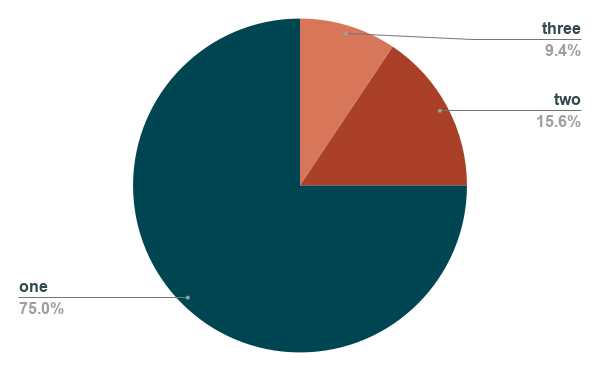
Results from last month's poll, "How many proposals did you submit as PI in Cycle 13?"  

Pie chart for responses to the question, How many proposals did you submit as PI in cycle 13?


Did you know?

The Snooping Project Interface (SnooPI) allows Principal Investigators (PIs) and Co-Is to follow their ALMA projects from the moment of proposal submission all the way to data delivery? PIs and Co-Is can download the proposal and project report and can access important information about their projects as well as receive news regarding their observations.


If you would like to contribute an ALMA science highlight, please contact the newsletter editor at Hannah.Stacey@eso.org.