Picture of the Week 
Computing at ESO Through the Ages — The amazing advance of technology
ESO turns fifty this year, and to celebrate this important anniversary, we are showing you glimpses into our history. Once a month during 2012, a special Then and Now comparison Picture of the Week shows how things have changed over the decades at the La Silla and Paranal Observatory sites, the ESO offices in Santiago de Chile, and the Headquarters in Garching bei München, Germany.
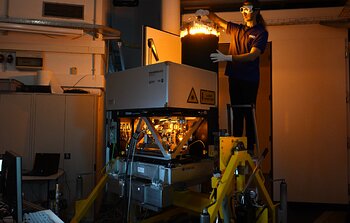
Our pair of photographs this month show how the computing power used by ESO has changed dramatically over time. Both photographs show Austrian astronomer Rudi Albrecht in front of ESO’s computer systems, but on dates separated by decades.
In the historical image, taken in 1974 in the ESO offices in Santiago, Chile, we can see Albrecht, pencil in hand, poring over code in front of a teletype. He was working on software for the Spectrum Scanner attached to the ESO 1-metre telescope [1] located at the La Silla Observatory. The data were processed in Santiago using the Hewlett Packard 2116 minicomputer which can be seen behind the printer. This bulky computer, with one processor and a breathtaking 16 kilobytes of magnetic-core memory (!), stored the results on magnetic tape, ready for further processing by visiting astronomers on computers at their home institutes. To handle files on tape that were larger than the available memory, Albrecht developed a virtual memory system, which he contributed to the Hewlett Packard Software Center.
The present-day photograph shows Albrecht in the Data Centre at ESO Headquarters in Garching bei München, Germany, which archives and distributes data from ESO’s telescopes. He is in front of a rack containing a system with 40 processor cores, 138 terabytes of storage capacity and 83 gigabytes of RAM — over 5 million times more than the machine used by him back in 1974! Even the tablet computer he is holding far outperforms the older machine, and provides a modern alternative to pencil and paper.
Over the years, ESO’s computing systems have developed to handle the flood of scientific data from the observatory’s telescopes. Advances in telescope, detector, and computer technology mean that observatories now produce massive quantities of images, spectra, and catalogues. For instance, the two survey telescopes at Paranal, the VST and VISTA, together produce over 100 terabytes of data per year. It’s a far cry from the days of magnetic tape and 16 kilobytes of memory!
Notes
[1] The ESO 1-metre telescope was decommissioned in 1994.
The Southern Milky Way Above ALMA
ESO Photo Ambassador Babak Tafreshi snapped this remarkable image of the antennas of the Atacama Large Millimeter/submillimeter Array (ALMA), set against the splendour of the Milky Way. The richness of the sky in this picture attests to the unsurpassed conditions for astronomy on the 5000-metre-high Chajnantor plateau in Chile’s Atacama region.
This view shows the constellations of Carina (The Keel) and Vela (The Sails). The dark, wispy dust clouds of the Milky Way streak from middle top left to middle bottom right. The bright orange star in the upper left is Suhail in Vela, while the similarly orange star in the upper middle is Avior, in Carina. Of the three bright blue stars that form an “L” near these stars, the left two belong to Vela, and the right one to Carina. And exactly in the centre of the image below these stars gleams the pink glow of the Carina Nebula (eso1208).
ESO, the European partner in ALMA, is providing 25 of the 66 antennas that will make up the completed telescope. The two antennas closest to the camera, on which the careful viewer can find the markings “DA-43” and “DA-41”, are examples of these European antennas. Construction of the full ALMA array will be completed in 2013, but the telescope is already making scientific observations with a partial array of antennas.
Babak Tafreshi is founder of The World At Night, a programme to create and exhibit a collection of stunning photographs and time-lapse videos of the world’s most beautiful and historic sites against a night-time backdrop of stars, planets and celestial events.
ALMA, an international astronomy facility, is a partnership of Europe, North America and East Asia in cooperation with the Republic of Chile. ALMA construction and operations are led on behalf of Europe by ESO, on behalf of North America by the National Radio Astronomy Observatory (NRAO), and on behalf of East Asia by the National Astronomical Observatory of Japan (NAOJ). The Joint ALMA Observatory (JAO) provides the unified leadership and management of the construction, commissioning and operation of ALMA.
#L
Icy Penitents by Moonlight on Chajnantor
Babak Tafreshi, one of the ESO Photo Ambassadors, has captured a curious phenomenon on the Chajnantor plateau, the site of the Atacama Large Millimeter/submillimeter array (ALMA).
These bizarre ice and snow formations are known as penitentes (Spanish for “penitents”). They are illuminated by the light of the Moon, which is visible on the right on the photograph. On the left, higher in the sky, the Large and Small Magellanic Clouds can be faintly seen, while the reddish glow of the Carina Nebula appears close to the horizon on the far left.
The penitentes are natural marvels found in high-altitude regions, such as here in the Chilean Andes, typically more than about 4000 metres above sea level. They are thin spikes and blades of hardened snow or ice, which often form in clusters, with their blades pointing towards the Sun. They attain heights ranging from a few centimetres, resembling low grass, up to five metres, giving an impression of an ice forest in the middle of the desert.
The precise details of the mechanism that forms the penitentes are still not completely understood. For many years, people of the Andes believed the penitentes to be the result of strong winds prevalent in the Andes mountains. However, the strong winds have only a limited role in shaping these icy pinnacles. Nowadays, it is believed that they are the product of a combination of physical phenomena.
The process begins with sunlight shining on the surface of the snow. Due to the very dry conditions in these desert regions, the ice sublimes rather than melts — it goes from solid to gas without melting and passing through a liquid water phase. Surface depressions in the snow trap reflected light, leading to more sublimation and deeper troughs. Within these troughs, increased temperature and humidity means that melting can occur. This positive feedback accelerates the growth of the characteristic structure of the penitentes.
These icy statues are named after the spiked hats of the nazarenos, members of a brotherhood that participates in Easter processions around the world. It is not hard to picture them as an assembly of icy monks, congregating in the moonlight.
The image was taken by the side of the road that leads to ALMA. The observatory, which started Early Science operations on 30 September 2011, will eventually consist of 66 high-precision antennas operating together as a single giant telescope.
ALMA, an international astronomy facility, is a partnership of Europe, North America and East Asia in cooperation with the Republic of Chile. ALMA construction and operations are led on behalf of Europe by ESO, on behalf of North America by the National Radio Astronomy Observatory (NRAO), and on behalf of East Asia by the National Astronomical Observatory of Japan (NAOJ). The Joint ALMA Observatory (JAO) provides the unified leadership and management of the construction, commissioning and operation of ALMA.
Links
#L
Getting the VLT Ready for Even Sharper Images
This picture shows one of ESO’s Very Large Telescope (VLT) Unit Telescopes (UT4) whilst it was recently briefly held prisoner by ESO’s engineers. It was surrounded by a temporary cage of scaffolding as part of the preparations for the new Adaptive Optics Facility (AOF). This project will convert UT4 into a fully adaptive telescope. The AOF will correct for the blurring effects of the Earth’s atmosphere and will allow much sharper images to be achieved with the HAWK-I and MUSE instruments.
Many new components are being added to UT4 as part of the AOF. Among these is the deformable secondary mirror (DSM): a thin-shell mirror, 1.1 metres in diameter, but just 2 millimetres thick. This mirror is thin enough to be easily deformed by more than a thousand actuators, up to a thousand times per second in order to counteract the atmosphere’s distortions. The DSM is the largest adaptive mirror manufactured to date (ann12015). Another vital element is the four Laser Guide Star Facility (4LGSF) — four special telescopes that fire laser beams high into the atmosphere to create artificial stars [1] (ann12012). Finally, the GRAAL and GALACSI adaptive optics modules will be responsible for analysing the light coming back from the laser guide stars.
This picture shows an ESO engineer supervising the work performed on UT4. To allow full access to the telescope, the cell of the primary mirror has been temporarily removed. Cables and pipes have also been removed and new ones have been installed. Mounting brackets have been added in preparation for the installation of the 4LGSF electronic cabinets and launch telescopes.
Notes
[1] The laser beams excite a layer of sodium atoms at an altitude of 90 kilometres in the atmosphere, making them glow as artificial stars.
Three Very Different Telescopes at La Silla
ESO turns fifty this year, and to celebrate this important anniversary, we are showing you glimpses into its history. Once a month during 2012, a special Then and Now Picture of the Week shows how things have changed over the decades at the La Silla and Paranal observatory sites, the ESO offices in Santiago de Chile, and the Headquarters in Garching bei München, Germany.
These two photographs were taken on the highest peak of La Silla, a mountain with an altitude of 2400 metres, at the edge of the Chilean Atacama Desert. La Silla was ESO’s first observatory site. The historical photograph, taken in 1975, shows some of the trucks and other equipment used for the construction of the dome of the ESO 3.6-metre telescope, which was underway behind the photographer. On the left are the water tanks for the site.
In the modern-day photograph, three new telescopes have appeared, all looking very different from each other. To the right of the water tanks is the ESO New Technology Telescope (NTT), which had its first light on 23 March 1989. This 3.58-metre telescope was the first ever to have a computer-controlled main mirror, which could adjust its shape during observations to optimise image quality. The octagonal enclosure housing the NTT is another technological breakthrough, ventilated by a system of flaps that makes air flow smoothly across the mirror, reducing turbulence and leading to sharper images.
To the right of the NTT is the Swiss 1.2-metre Leonhard Euler Telescope, which has a more traditional dome-shaped enclosure. It is operated by the Geneva Observatory at the Université de Genève in Switzerland, and had its first light on 12 April 1998. It is used to search for exoplanets in the southern sky; with its first discovery being a planet in orbit around the star Gliese 86 (see eso9855). The telescope also observes variable stars, gamma-ray bursts and active galactic nuclei.
In the foreground on the right is a building nicknamed the sarcofago (sarcophagus). This houses the TAROT (Télescope à Action Rapide pour les Objets Transitoires, or Rapid Action Telescope for Transient Objects), which started work at La Silla on 15 September 2006. This fast moving, relatively tiny 25-centimetre robotic telescope reacts extremely quickly to alerts from satellites about gamma-ray bursts, to pinpoint the positions of these dramatic but fleeting events. Observing these cosmic explosions lets astronomers study the formation of black holes and the evolution of stars in the early Universe. TAROT is operated by a consortium led by Michel Boër from Observatoire de Haute Provence in France.
The NTT is operated by ESO, while the Leonhard Euler Telescope and TAROT are among the national and project telescopes hosted at La Silla. Even today, over 40 years after its inauguration, La Silla remains at the forefront of astronomy.
Links
- The historical image
- The present-day image
- Side-by-side composite of the historical and present-day images
- More about La Silla
- Press release on the occasion of the 40th anniversary, in 2009, of La Silla’s inauguration
- ESO timeline
Sun, Moon and Telescopes above the Desert
The otherworldly beauty of Chile’s Atacama Desert, home of ESO’s Very Large Telescope (VLT), stretches to the horizon in this panorama. On Cerro Paranal, the highest peak in the centre of this image, are the four giant Unit Telescopes of the VLT, each of which has a mirror with a diameter of 8.2 metres. On the peak to the left of Cerro Paranal is the VISTA survey telescope. This 4.1-metre telescope surveys broad swathes of the heavens, searching for interesting targets which the VLT, as well as other telescopes on the ground and in space, will study in greater detail.
This region offers some of the best conditions for viewing the night sky found anywhere on our planet. On the right of this 360-degree panorama, the Sun is setting over the Pacific Ocean, throwing long shadows across the mountainscape. On the left, the Moon gleams in the sky. Soon, the night’s observations will begin.
This wonderful panorama was made by Serge Brunier, an ESO Photo Ambassador. It is one of many awe-inspiring images in which he captures ESO’s observatories, their beautiful locations, and the splendour of the skies above them.
Links
The Moon and the Arc of the Milky Way
ESO Photo Ambassador Stéphane Guisard captured this astounding panorama from the site of ALMA, the Atacama Large Millimeter/submillimeter Array, in the Chilean Andes. The 5000-metre-high and extremely dry Chajnantor plateau offers the perfect place for this state-of-the-art telescope, which studies the Universe in millimetre- and submillimetre-wavelength light.
Numerous giant antennas dominate the centre of the image. When ALMA is complete, it will have a total of 54 of these 12-metre-diameter dishes. Above the array, the arc of the Milky Way serves as a resplendent backdrop. When the panorama was taken, the Moon was lying close to the centre of the Milky Way in the sky, its light bathing the antennas in an eerie night-time glow. The Large and Small Magellanic Clouds, the biggest of the Milky Way's dwarf satellite galaxies, appear as two luminous smudges in the sky on the left. A particularly bright meteor streak gleams near the Small Magellanic Cloud.
On the right, some of ALMA’s smaller 7-metre antennas — twelve of which will be used to form the Atacama Compact Array — can be seen. Still further on the right shine the lights of the Array Operations Site Technical Building. And finally, looming behind this building is the dark, mountainous peak of Cerro Chajnantor.
ALMA, an international astronomy facility, is a partnership of Europe, North America and East Asia in cooperation with the Republic of Chile. ALMA construction and operations are led on behalf of Europe by ESO, on behalf of North America by the National Radio Astronomy Observatory (NRAO), and on behalf of East Asia by the National Astronomical Observatory of Japan (NAOJ). The Joint ALMA Observatory (JAO) provides the unified leadership and management of the construction, commissioning and operation of ALMA.
Links
APEX Stands Sentry on Chajnantor
The Atacama Pathfinder Experiment (APEX) telescope looks skyward during a bright, moonlit night on Chajnantor, one of the highest and driest observatory sites in the world. Astronomical treasures fill the sky above the telescope, a testament to the excellent conditions offered by this site in Chile’s Atacama region.
On the left shine the stars that make up the tail of the constellation of Scorpius (The Scorpion). The scorpion’s “stinger” is represented by the two bright stars that are particularly close to each other. Reaching across the sky and looking like a band of faint, glowing clouds is the plane of the Milky Way.
Between Scorpius and the next constellation to the right, Sagittarius (The Archer), which looms over APEX’s dish, a sparkling cluster of stars can be clearly seen. This is the open cluster Messier 7, also known as Ptolemy’s Cluster. Below Messier 7 and slightly to the right is the Butterfly Cluster, Messier 6. Further to the right, just above the edge of APEX’s dish, is a faint cloud which looks like a bright smudge. This is the famous Lagoon Nebula (see eso0936 for a closer view).
With a primary dish diameter of 12 metres, APEX is the largest single-dish submillimetre-wavelength telescope operating in the southern hemisphere. As the telescope’s name suggests, it is blazing a trail for the biggest submillimetre observatory in the world, the Atacama Large Millimeter/submillimeter Array (ALMA), which will be completed in 2013 (eso1137). APEX will share space with the 66 antennas of ALMA on the 5000-metre-high Chajnantor plateau in Chile. The APEX telescope is based on a prototype antenna constructed for the ALMA project, and it will find many targets that ALMA will be able to study in great detail.
ESO Photo Ambassador Babak Tafreshi made this panorama using a telephoto lens. Babak is also the founder of The World At Night, a programme to create and exhibit a collection of stunning photographs and time-lapse videos of the world’s most beautiful and historic sites against a nighttime backdrop of stars, planets and celestial events.
More information
APEX is a collaboration between the Max-Planck-Institut für Radioastronomie (MPIfR), the Onsala Space Observatory (OSO), and ESO, with operations of the telescope entrusted to ESO.
ALMA, an international astronomy facility, is a partnership of Europe, North America and East Asia in cooperation with the Republic of Chile. ALMA construction and operations are led on behalf of Europe by ESO, on behalf of North America by the National Radio Astronomy Observatory (NRAO), and on behalf of East Asia by the National Astronomical Observatory of Japan (NAOJ). The Joint ALMA Observatory (JAO) provides the unified leadership and management of the construction, commissioning and operation of ALMA.
Links
#L
All Around Chajnantor — A 360-degree panorama
Although Cerro Chico reaches the remarkable altitude of 5300 metres above sea level, it is only a small mountain in the majestic landscape of the Andean plateaux. Indeed, its own name means simply “small mountain” in Spanish. However, due to its position on the plateau of Chajnantor, the top of Cerro Chico offers an excellent and relatively easy-to-reach vantage point from which to enjoy this stunning view.
This 360-degree panoramic picture is centred on the northeast, where the highest volcanoes — most of them above 5500 metres — are seen. In the centre is Cerro Chajnantor itself. To the right, on the plateau, is the Atacama Pathfinder Experiment (APEX) telescope with Cerro Chascon behind it. Further to the right, to the southeast, the Chajnantor plateau is almost fully visible. In addition to the APEX telescope, three Atacama Large Millimeter/submillimeter Array (ALMA) antennas can be seen, on the right. Many more have been added since this panorama was taken.
On the left of Cerro Chajnantor is Cerro Toco. Further to the left, in the northwest, we can see the distinctive conical shape of Licancabur volcano.
On the Chajnantor plateau, at 5000 metres altitude, the air is so thin and dry that it seems never to fill one’s lungs. Thanks to these extreme conditions, the millimetre and submillimetre radiation coming from the rest of the Universe can pass through what remains of the Earth’s atmosphere above the site, and can be detected from the ground with suitably sensitive telescopes such as ALMA and APEX.
APEX is a collaboration between the Max Planck Institute for Radio Astronomy (MPIfR), the Onsala Space Observatory (OSO) and ESO. The telescope is operated by ESO.
ALMA, an international astronomy facility, is a partnership of Europe, North America and East Asia in cooperation with the Republic of Chile. ALMA construction and operations are led on behalf of Europe by ESO, on behalf of North America by the National Radio Astronomy Observatory (NRAO), and on behalf of East Asia by the National Astronomical Observatory of Japan (NAOJ). The Joint ALMA Observatory (JAO) provides the unified leadership and management of the construction, commissioning and operation of ALMA.
Links
- This panorama, and others, can be seen as part of a stunning virtual tour of Chajnantor
- More ESO virtual tours
La Silla, the First Home for ESO’s Telescopes — ESO’s first observatory site Then and Now
ESO turns fifty this year, and to celebrate this important anniversary, we are showing you glimpses into our history. Once a month during 2012, a special Then and Now comparison Picture of the Week shows how things have changed over the decades at the La Silla and Paranal Observatory sites, the ESO offices in Santiago de Chile, and the Headquarters in Garching bei München, Germany.
This historical image was taken around 1970 from the La Silla dormitories, located lower on the mountain than the telescope domes. The photo looks up towards the highest point of the mountain, on the left. The metallic structure visible near the top of this peak is not a telescope, but a water tank for the site. The white dome in the centre of the image is that of the ESO 1-metre Schmidt telescope, which started work in February 1972. On the far right of the image is the ESO 1-metre telescope, just visible over the ridge, and to the left of that one can just see the top of the Grand Prisme Objectif telescope.
In the present-day photograph, the dormitory buildings remain, but more have been built over the decades. The most striking changes, though, are visible around La Silla’s peak on the left. At the highest point is the ESO 3.6-metre telescope, which started operating in November 1976 and is still in use today. The 3.6-metre is home to HARPS, the foremost exoplanet hunter (see eso1134 and eso1214 for some recent results). The 3.6-metre, planned from the inception of ESO, was to crown the La Silla Observatory as its biggest telescope, and was a major engineering feat of its time. The smaller dome visible in front of the 3.6-metre is the 1.4-metre Coudé Auxiliary Telescope, which complemented its bigger neighbour.
To the right of the 3.6-metre is the 3.58-metre New Technology Telescope (NTT), recognisable by the angular, metallic appearance of its enclosure. The NTT, which started operating in March 1989, was the first telescope in the world to use a computer-controlled mirror. It was used as a precursor for the Very Large Telescope, to test many new technologies that were then used in the later telescope.
Other new sights in the modern-day photograph are the workshop building below the water tanks, and the Differential Image Motion Monitor (DIMM), used to measure the atmospheric seeing, located on stilts between the workshop and the ESO 1-metre Schmidt telescope.
Even today, La Silla remains a very active observatory where important discoveries are made. Both the NTT and the 3.6-metre telescope provided vital data which led to the discovery of the accelerating expansion of the Universe — a discovery for which the 2011 Nobel Prize in Physics was awarded.
Links
- The historical image
- The present-day image
- Side-by-side composite of the historical and present-day images
- More about La Silla
- Press release on the occasion of the 40th anniversary, in 2009, of La Silla’s inauguration
- ESO timeline
Wish You Were Here?
French photographer Serge Brunier — one of ESO’s Photo Ambassadors — has created this seamless 360-degree panorama of the Chajnantor plateau in the Atacama Desert, where the Atacama Large Millimeter/submillimeter Array (ALMA) is under construction.
The panorama projection has slightly warped the shapes of the ALMA antennas, but it still gives a sense of what it would be like to stand in the middle of this impressive new observatory. The 360-degree view also demonstrates the complete isolation of the Chajnantor plateau; at an altitude of 5000 metres, the backdrop is almost featureless, except for a few mountain peaks and hilltops.
Although constructing such an ambitious telescope project in a remote and harsh environment is challenging, the high altitude location is perfect for submillimetre astronomy. That’s because water vapour in the atmosphere absorbs this type of radiation, but the air is much drier at high altitude sites such as Chajnantor.
ALMA started its first scientific observations on 30 September 2011 with a partial array of antennas. When the observatory is completed, the impressive sight of fifty 12-metre antennas — as well as a smaller array of four 12-metre and twelve 7-metre antennas, known as the Atacama Compact Array (ACA) — will make the isolated landscape seem slightly less empty. In the meantime, photographs like this one are documenting the progress of a new world-class telescope facility.
ALMA, an international astronomy facility, is a partnership of Europe, North America and East Asia in cooperation with the Republic of Chile. ALMA construction and operations are led on behalf of Europe by ESO, on behalf of North America by the National Radio Astronomy Observatory (NRAO), and on behalf of East Asia by the National Astronomical Observatory of Japan (NAOJ). The Joint ALMA Observatory (JAO) provides the unified leadership and management of the construction, commissioning and operation of ALMA.
Links
The VLT goes lion hunting
The Very Large Telescope has captured another member of the Leo I group of galaxies, in the constellation of Leo (The Lion). The galaxy Messier 95 stands boldly face-on, offering an ideal view of its spiral structure. The spiral arms form an almost perfect circle around the galactic centre before they spread out, creating a mane-like effect of which any lion would be proud.
Another, perhaps even more striking, feature of Messier 95 is its blazing golden core. It contains a nuclear star-forming ring, almost 2000 light-years across, where a large proportion of the galaxy’s star formation takes place. This phenomenon occurs mostly in barred spiral galaxies such as Messier 95 and our home, the Milky Way.
In the Leo I group, Messier 95 is outshone by its brother Messier 96 (see potw1143). Messier 96 is in fact the brightest member of the group and — as “leader of the pride” — also gives Leo I its alternative name of the M 96 group. Nevertheless, Messier 95 also makes for a spectacular image.
Stop press! By coincidence Messier 95 is the host of a probable supernova that was first spotted on 17 March 2012. Discovery details are here. And as another coincidence both supernova and galaxy are currently very close to the brilliant planet Mars amongst the stars of Leo. Please note that the observations used to make this Picture of the Week were taken before the supernova occurred, and therefore the supernova itself does not appear in this image.
A Dusting of Snow in the Atacama Desert
The domes of ESO’s Very Large Telescope sit atop Cerro Paranal, basking in the sunlight of another glorious cloudless day. But something is different about this picture: a fine layer of snow has settled across the desert landscape. This isn’t something you see every day: quite the opposite in fact, as the Atacama Desert gets almost no precipitation.
Several factors contribute to the dry conditions in the Atacama. The Andes mountain range blocks rain from the east, and the Chilean Coast Range from the west. The cold offshore Humboldt current in the Pacific Ocean creates a coastal inversion layer of cool air, which prevents rain clouds from developing. A region of high pressure in the south-eastern Pacific Ocean creates circulating winds, forming an anticyclone, which also helps to keep the climate of the Atacama dry. Thanks to all these factors, the region is widely regarded as the driest place on Earth!
At Paranal, the precipitation levels are usually just a few millimetres per year, with the humidity often dropping below 10%, and temperatures ranging from -8 to 25 degrees Celsius. The dry conditions in the Atacama Desert are a major reason why ESO chose it, and Cerro Paranal, to host the Very Large Telescope. While the very occasional snowfall may temporarily disrupt the dry conditions here, it does at least produce unusual views of rare beauty.
This photograph was taken by ESO Photo Ambassador Stéphane Guisard on 1 August 2011.
Links
A Window to the Past — La Silla’s transformation through time
ESO turns fifty this year, and to celebrate this important anniversary, we are showing you glimpses into our history. Once a month during 2012, a special “Then and Now” comparison Picture of the Week shows how things have changed over the decades at the La Silla and Paranal observatory sites, the ESO offices in Santiago de Chile, and the Headquarters in Garching bei München, Germany.
Here are two photographs of La Silla, taken in June 1968 and the present day from near the observatory’s water tanks, looking over the rest of the site. You can examine the changes with our mouseover image comparison.
In the historical image, the provisional residential area is visible in the foreground. The three telescopes in the background are, from left to right, the Grand Prism Objectif (GPO, first light in 1968), the ESO 1-metre telescope (first light in 1966), and the ESO 1.5-metre telescope (first light in 1968). These three telescopes were the first at La Silla. The white dome closest to the viewer is the ESO 1-metre Schmidt telescope, which began work in 1971.
Today, these four domes are still present, but the first three telescopes have been decommissioned. The ESO 1-metre Schmidt is still in operation, but is now a project telescope dedicated to the LaSilla–QUEST Variability survey (see potw1201a).
The present-day photograph also shows two new telescopes. The silver dome is that of the MPG/ESO 2.2-metre telescope, which has been in operation since early 1984 and is on indefinite loan to ESO from the Max-Planck-Gesellschaft. On the far left is the Danish 1.54-metre telescope, in use since 1979, which is one of several national telescopes at La Silla.
Links
- More about La Silla
- Press release on the occasion of the 40th anniversary, in 2009, of La Silla’s inauguration
- ESO timeline
Spinning into Action
The dynamism of ESO's Very Large Telescope in operation is wonderfully encapsulated in this unusual photograph, taken just after sunset at the moment Unit Telescope 1 starts work. An extended exposure time of 26 seconds has allowed ESO Photo Ambassador Gerhard Hüdepohl to record the movement of the dome, looking out through the opening from within, as the system swings into action. The rotating walls of the dome look like an ethereal swirl through which a slice of the Atacama Desert can be glimpsed, while the crisp dusk sky provides a splash of cool blue.
The telescope structure, seen stationary in the centre of the image, houses a mirror 8.2 metres in diameter, designed to collect light from the far reaches of our Universe. The dome itself is also an engineering marvel, moving with extreme precision and allowing for careful temperature control lest warm air currents disrupt observations.
Links
Boldly going up Cerro Paranal
ESO’s Paranal Observatory facilities, such as the Residencia, give people who work at the site a welcome shelter from the surrounding inhospitable environment. In spite of that, they also offer interesting options for those who wish to enjoy the stark and silent beauty of the Atacama Desert. See this stunning panorama!
Among these is the Star Track, a walking path which connects the Residencia with the Very Large Telescope (VLT) platform, on the 2600-metre summit of Cerro Paranal. Built in 2001, the Star Track covers about two kilometres in distance and a difference in height of 200 metres. The last part of the track snakes around the west side of the mountain, offering incomparable views.
This 360-degree panoramic picture is centred facing north, so the right and left edges of the picture correspond to the south. To the north, the VLT control room and part of one of the Unit Telescope enclosures can just be seen peeking over a local bump in the terrain that hides most of the Paranal summit. To the west, clouds cover the Pacific Ocean, only 12 kilometres away. To the east, the facade and dome of the Residencia can be seen in the distance.
Links
- This panorama, and others, can be seen as part of a stunning virtual tour of Paranal and Armazones, at: http://www.eso.org/public/outreach/products/virtualtours/armazones.html
- More ESO virtual tours are available at: http://www.eso.org/public/outreach/products/virtualtours/
The Heart of the Milky Way, for Valentine’s Day
There is a lot to love about astronomy, and — in time for Valentine's Day — photographer Julien Girard offers a "heartfelt” example in this image. A bright pink symbol of love appears to float ethereally against the backdrop of the night sky over ESO's Paranal Observatory in northern Chile. Girard drew the heart in the air by shining a tiny flashlight keychain at the camera during a 25-second exposure with a tripod.
The central region of the Milky Way appears in the middle of the heart, as the plane of our galaxy stretches across the image. The stars of the constellation of Corona Australis (The Southern Crown) form a glittering arc of jewels at the top of the heart's left lobe. The diffuse glow to the left of the heart's lowest point is zodiacal light, caused by the scattering of light from the Sun by dust particles in the Solar System.
On the far right horizon, the 8.2-metre telescopes of the ESO Very Large Telescope (VLT) facility stand out in silhouette atop Cerro Paranal. The lights of a car driving down from the observatory platform can be seen just to the left of the telescopes.
Julien Girard is an ESO astronomer based in Chile, who works at the VLT. He is the instrument scientist for the NACO adaptive optics instrument on the VLT’s Unit Telescope 4. He submitted this photograph to the Your ESO Pictures Flickr group, from where it was picked out as an ESO Picture of the Week.
Links
- This photograph, with annotations, on Julien Girard’s Flickr photostream
- Julien Girard’s Flickr photostream
- Your ESO Pictures Flickr group
A Drive Through Time — How telescopes, and cars, have changed at La Silla
ESO turns fifty this year, and to celebrate this important anniversary, we are showing you glimpses into its history. Once a month during 2012, a special “Then and Now” comparison Picture of the Week shows how things have changed over the decades at the La Silla and Paranal observatory sites, the ESO offices in Santiago de Chile, and the Headquarters in Garching bei München, Germany.
These two photographs show the La Silla Observatory in the late 1960s and the present day. You can also examine the differences between the two photographs with our mouseover comparison. The telescopes aren’t the only things that have changed; the cars in the photos also show the passing of time. The Volkswagen 1600 Variant in the first picture has been replaced in the second picture by a Suzuki 4WD. Nowadays, all ESO vehicles on La Silla are white, to improve visibility at night.
Standing alone in the centre of the historical image is the ESO 1-metre Schmidt telescope, which began work in 1971. Back then, it used photographic plates to take wide-field images of the southern sky four degrees across — large enough to fit the full Moon 64 times over. The huts lining the road to the right of the image are where astronomers used to sleep.
Fast forward to 2011 and another two telescopes appear. On the left is the MPG/ESO 2.2-metre telescope, which has been in operation since 1984. In fact, its construction is why the modern-day photograph could not be taken from exactly the same place! On the peak to the right is the New Technology Telescope (NTT) commissioned later in 1989. Both these telescopes have had enormous successes over the years and are still in operation today. And the huts for the astronomers have in the meantime been replaced with a more comfortable “hotel” on the edge of the site.
As for the Schmidt telescope, still standing in the middle, its original photographic camera was decommissioned in December 1998, but it lives on as a project telescope. It is being used to conduct the LaSilla–QUEST Variability survey: a search for so-called transient objects in the southern sky, such as new Pluto-sized dwarf planets, or supernovae. Its new camera has a mosaic of 112 CCDs, with a total of 160 million pixels — an excellent example of how modern technology can give an old telescope a new lease of life!
Links
- The historical image
- The present day image
- More about La Silla
- Press release on the occasion of the 40th anniversary, in 2009, of La Silla’s inauguration
- ESO timeline
A Shadow at Sunrise
In this photograph, taken by ESO Photo Ambassador Gianluca Lombardi, the Sun is rising and bathing the Chilean Atacama Desert in a familiar soft reddish glow. But this image, from 13 July 2011, has also captured something out of the ordinary: a dark shadow lurking on the horizon.
Gianluca took this photograph from Cerro Armazones, looking west. Armazones is the future home of the world’s biggest eye on the sky: the upcoming European Extremely Large Telescope (E-ELT). The Sun rose behind Gianluca in just the right place to cast a daunting shadow of the 3060-metre-high mountain onto the Earth’s atmosphere in the distance. The shadow can be seen reaching over the vast desert landscape, and up across the horizon on the left side of the image.
The bright summit visible on the right of the image is Cerro Paranal, at an altitude of 2600 metres. It is only 20 kilometres from Cerro Armazones, and is the home of ESO’s Very Large Telescope. Both sites have exceptional astronomical observing conditions. To its right is the adjacent peak where the VISTA survey telescope is located and to its left, on the horizon, are the Paranal Observatory’s basecamp and Residencia.
The white road winding across the bottom-left corner of the photograph is the route to the summit of Cerro Armazones.
Links
- This image, as well as many more stunning shots from Gianluca Lombardi, can be found on his Flickr photostream.
- Find out more about the ESO Photo Ambassadors here.
- Find out more about Cerro Armazones and the E-ELT here.
Barred Spiral Galaxy Swirls in the Night Sky
This image shows the swirling shape of galaxy NGC 2217, in the constellation of Canis Major (The Great Dog). In the central region of the galaxy is a distinctive bar of stars within an oval ring. Further out, a set of tightly wound spiral arms almost form a circular ring around the galaxy. NGC 2217 is therefore classified as a barred spiral galaxy, and its circular appearance indicates that we see it nearly face-on.
The outer spiral arms have a bluish colour, indicating the presence of hot, luminous, young stars, born out of clouds of interstellar gas. The central bulge and bar are yellower in appearance, due to the presence of older stars. Dark streaks can also be seen in places against the galaxy’s arms and central bulge, where lanes of cosmic dust block out some of the starlight.
The majority of spiral galaxies in the local Universe — including our own Milky Way — are thought to have a bar of some kind, and these structures play an important role in the development of a galaxy. They can, for example, funnel gas towards the centre of the galaxy, helping to feed a central black hole, or to form new stars.
ALMA’s Grand Antennas
Workers on the Atacama Large Millimeter/submillimeter Array (ALMA) project stand next to three of the telescope’s antennas. This photograph gives a real sense of the scale of the giant dishes, whose 12-metre diameters are about seven times the average human height. When completed, ALMA will consist of 66 high-precision antennas, 54 of them with 12-metre dishes as seen in this image, and 12 more compact ones with diameters of 7 metres. The yellow 28-wheel transporter vehicle, which has to be powerful enough to carry the 100-tonne antennas, is built on a similarly giant scale.
This photograph was taken at the 2900-metre-high ALMA Operations Support Facility in the foothills of the Chilean Andes, where the antennas are assembled and tested. On the left is one of the European ALMA antennas, pointing at the horizon. Behind it is one of the antennas provided to the project by Japan, while on the right, on the transporter vehicle and pointing upwards, is another European antenna. This is the first European antenna starting its journey up to the Array Operations Site on the Chajnantor plateau, photographed in July 2011 (see eso1127). Since this photograph was taken, the antennas, and others like them, have been put into operation on Chajnantor as ALMA has made its first scientific observations (see eso1137). ALMA is designed to study the cool Universe — the relic radiation of the Big Bang and the molecular gas and dust from which stars, planets and galaxies originate.
ALMA, an international astronomy facility, is a partnership of Europe, North America and East Asia in cooperation with the Republic of Chile. ALMA construction and operations are led on behalf of Europe by ESO, on behalf of North America by the National Radio Astronomy Observatory (NRAO), and on behalf of East Asia by the National Astronomical Observatory of Japan (NAOJ). The Joint ALMA Observatory (JAO) provides the unified leadership and management of the construction, commissioning and operation of ALMA.
Twenty-five European ALMA antennas are being provided by ESO through a contract with the European AEM Consortium. ALMA will also have 25 antennas provided by North America, and 16 by East Asia.
Mapping Dark Matter in Galaxies
The picture is part of the COMBO-17 survey (Classifying Objects by Medium-Band Observations in 17 Filters), a project dedicated to recording detailed images of small patches of the sky through filters of 17 different colours. The area covered in this image is only about the size of the full Moon, but thousands of galaxies can be identified just within this small region.
The image was taken with an exposure time of almost seven hours, which allowed the camera to capture the light from very faint and distant objects, as well as those that are closer to us. Galaxies with clear and regular structures, such as the spiral specimen viewed edge-on near the upper left corner, are only up to a few billion light-years away. The fainter, fuzzier objects are so far away that it has taken nine or ten billion years for their light to reach us.
The COMBO-17 survey is a powerful tool for studying the distribution of dark matter in galaxies. Dark matter is a mysterious substance that does not emit or absorb light and can only be detected by its gravitational pull on other objects. Some of the closer galaxies pictured act as lenses that distort the light coming from more distant galaxies placed along the same line of sight. By measuring this distortion, an effect known as gravitational lensing, astronomers are able to understand how dark matter is distributed in the objects that act as lenses.
The distortion is weak and, therefore, almost imperceptible to the human eye. However, because surveying the sky with 17 filters allows extremely precise distance measurements, it is possible to determine if two galaxies that appear to lie close to each other are actually at very different distances from the Earth. After identifying the galactic lensing systems, the distortion can be measured by averaging over thousands of galaxies. With more than 4000 galactic lenses identified, this COMBO-17 survey is an ideal method to help astronomers to understand the dark matter better.
This image was taken with three of the 17 filters from the project: B (blue), V (green), and R (red). Data through an additional near-infrared filter was also used.
Links
A Glimpse into the Past — Then and Now at La Silla Observatory
ESO turns 50 this year, and to celebrate this important anniversary, we will be showing you glimpses into our history. Once a month throughout 2012, a special “then and now” comparison Picture of the Week will show how things have changed over the decades at the La Silla and Paranal observatory sites, the ESO offices in Santiago de Chile, and the Headquarters in Garching bei München, Germany.
Our first stop on this journey through time is at La Silla, the first of ESO’s observatory sites. The historical image was taken in the late 1960s or early 1970s from the dome of the ESO 1.52-metre telescope, which had its first light in 1968. A second photograph, taken in the present day, shows how much the observatory has changed over the decades. You can examine the changes with our mouseover image comparison.
In the historical image, we can see the ESO 1-metre telescope in the foreground on the right, with the Grand Prism Objectif telescope (GPO) just peeking out from behind. The third telescope in this photo is the Schmidt 1-metre telescope, on the left. Behind it, at a higher level, are the water tanks of the observatory.
Moving through time to the present-day, we can see how much La Silla has evolved, with many more telescopes on the site. The ESO 3.6-metre telescope and the adjacent Coudé Auxiliary Telescope now stand out on the highest peak. The angular enclosure of the New Technology Telescope (NTT) is just to the left, next to the water tanks. The 15-metre-diameter dish of the Swedish–ESO Submillimetre Telescope (SEST) watches the horizon on the far right.
The new photograph was taken from a slightly different position on top of the ESO 1.52-metre telescope building, so the GPO is now hidden behind the ESO 1-metre telescope in the foreground. The white dome that is just visible behind the 1-metre is the Danish 1.54-metre telescope. In the centre of the photo we now see the silvery dome of the MPG/ESO 2.2-metre telescope.
Although some telescopes at La Silla, such as the ESO 1-metre and 1.52-metre, and the SEST, are no longer in operation, others are still doing front-line astronomy. The ESO 3.6-metre telescope hosts the HARPS instrument, the world’s leading exoplanet hunter (see eso1134 for some recent results). The NTT has been used to help explain the formation of massive stars (see eso1029). Both telescopes provided vital data which led to the discovery of the accelerating expansion of the Universe — a discovery for which the 2011 Nobel Prize in Physics was awarded. The MPG/ESO 2.2-metre telescope has also produced a treasure trove of data from breathtaking wide-field images to studies of gamma-ray bursts, the most explosive events in the Universe.
Links
- The historical image
- The present-day image
- Side-by-side composite of the historical and present-day images
- More about La Silla
- Press release on the occasion of the 40th anniversary, in 2009, of La Silla’s inauguration
- ESO timeline
Inside Euler's Head — Or how to see a telescope through the walls of its dome
As night was falling over ESO’s La Silla Observatory in Chile on 20 December 2009, the sky was not yet dark enough for the telescopes to start observations. But conditions were perfect to perform a clever trick with the dome of the Swiss 1.2-metre Leonhard Euler Telescope: allowing us to peer inside with this photograph apparently taken through the dome.
This image is a 75-second exposure taken while the slit of the Euler telescope’s dome was performing half a rotation at full speed. Through the ghostly blur of the moving dome walls, the telescope is clearly visible. A dim light was switched on in the interior of the building especially for the purpose of this photo.
The picture was taken by Malte Tewes, a young astronomer from the École Polytechnique Fédérale de Lausanne in Switzerland, who had just finished a two-week observing run at the telescope on the evening in question. The next observer, Amaury Triaud, and the telescope’s technician, Vincent Mégevand (both pictured), were on site so they could operate the dome from the inside while Malte took the photograph from outside.
The road that leads to ESO’s nearby 3.6-metre telescope is visible lined by a chain of lights to the left of the image. In addition to the 3.6-metre telescope, the New Technology Telescope, and the MPG/ESO 2.2-metre telescope, La Silla Observatory also hosts several national and project telescopes that are not operated by ESO. The Euler telescope, named after the famous Swiss mathematician Leonhard Euler, is one of them.
Links
Llullaillaco, Clear as Day
Bathed in the pristine light of the Chilean Atacama Desert, the ESO VLT’s Auxiliary Telescope 2 stands on Cerro Paranal. It is one of four that are used with the Very Large Telescope Interferometer. During the day, its bulbous dome is closed, protecting the sensitive telescope within.
The magnificent 6739-metre volcano Llullaillaco stands proudly in the background of this photograph. Although it looks relatively close on the horizon, it is actually an incredible 190 kilometres away, on the border with Argentina. That Llullaillaco can be seen so clearly is evidence of the region’s unparallelled atmospheric conditions. The clear air is one of the many factors that make this such a wonderful location for astronomical observatories. It is from this excellent vantage point that ESO astronomers study objects that are not just hundreds of kilometres in the distance, but billions of light-years away.
This photograph was taken by ESO Photo Ambassador Gianluca Lombardi.
Links
ALMA's World At Night
This panoramic view of the Chajnantor plateau, spanning about 180 degrees from north (on the left) to south (on the right) shows the antennas of the Atacama Large Millimeter/submillimeter Array (ALMA) ranged across the unearthly landscape. Some familiar celestial objects can be seen in the night sky behind them. These crystal-clear night skies explain why Chile is the home of not only ALMA, but also several other astronomical observatories. This image is just part of an even wider panorama of Chajnantor.
In the foreground, the 12-metre diameter ALMA antennas are in action, working as one giant telescope, during the observatory’s first phase of scientific observations. On the far left, a cluster of smaller 7-metre antennas for ALMA’s compact array can be seen illuminated. The crescent Moon, although not visible in this image, casts stark shadows over all the antennas.
In the sky above the antennas, the most prominent bright “star” — on the left of the image — is in fact the planet Jupiter. The gas giant is the third brightest natural object in the night sky, after the Moon and Venus. The Large and Small Magellanic Clouds can also be clearly seen on the right of the image. The Large Magellanic Cloud looks like a puff of smoke, just above the rightmost antenna. The Small Magellanic Cloud is higher in the sky, towards the upper-right corner. Both “clouds” are in fact dwarf irregular galaxies, orbiting the Milky Way galaxy, at distances of about 160 000 and 200 000 light-years respectively.
On the far left of the panorama, just left of the foreground antennas, is the elongated smudge of the Andromeda galaxy. This galaxy, more than ten times further away than the Magellanic Clouds, is our closest major neighbouring galaxy. It is also the largest galaxy in the Local Group — the group of about 30 galaxies which includes our own — and contains approximately one trillion stars, more than twice as many as the Milky Way. It is the only major galaxy visible with the naked eye. Even though only its most central region is apparent in this image, the galaxy spans the equivalent of six full Moons in the sky.
This photograph was taken by Babak Tafreshi, the latest ESO Photo Ambassador. Babak is also founder of The World At Night, a programme to create and exhibit a collection of stunning photographs and time-lapse videos of the world’s most beautiful and historic sites against a nighttime backdrop of stars, planets and celestial events.
ALMA is being built on the Chajnantor plateau at an altitude of 5000 metres. The observatory, which started Early Science operations on 30 September 2011, will eventually consist of 66 antennas operating together as a single giant telescope. This international astronomy facility is a partnership of Europe, North America and East Asia in cooperation with the Republic of Chile. ALMA construction and operations are led on behalf of Europe by ESO, on behalf of North America by the National Radio Astronomy Observatory (NRAO), and on behalf of East Asia by the National Astronomical Observatory of Japan (NAOJ). The Joint ALMA Observatory (JAO) provides the unified leadership and management of the construction, commissioning and operation of ALMA.
Links
- Time-lapse videos of ALMA on Chajnantor made by Babak Tafreshi: one, two
- ESO Photo Ambassadors
- More about ALMA at ESO: http://www.eso.org/public/teles-instr/alma.html
- The Joint ALMA Observatory: http://www.almaobservatory.org/
- The World At Night: http://www.twanight.org/
#L
The VLT’s Next-generation Laser Launch Telescope
This telescope is an important new component of the Four Laser Guide Star Facility, which will sharpen the already excellent vision of ESO’s Very Large Telescope (VLT). Four powerful 20-watt lasers, fired to an altitude of 90 kilometres up in the atmosphere, will help the VLT correct the image distortion caused by turbulence in the air. The Netherlands Organisation for Applied Scientific Research (TNO) is developing the launch telescopes through which the laser beams will be fired. The first of these laser launch telescopes — known as the Optical Tube Assembly — is seen here in the cleanroom at TNO’s Van Leeuwenhoek Laboratory in Delft, the Netherlands, having recently held its Acceptance Review. A special anti-reflective coating gives the lens on the telescope a distinctive blue hue. The photograph was taken by Fred Kamphues, who appears on the left. He is project manager for the Optical Tube Assembly, and is also a new ESO Photo Ambassador. On the right is system engineer Rens Henselmans.
The Four Laser Guide Star Facility is part of the next generation Adaptive Optics Facility, to be installed on the VLT’s 4th Unit Telescope, Yepun, in 2013. Adaptive optics systems rapidly adjust a deformable mirror to counteract the distorting effect of atmospheric turbulence — the same effect that makes stars twinkle — in real time. To do this, they use a guide star as a reference, since the star should appear as a sharp point when the effect of the atmosphere is removed. This lets the telescope make images almost as sharp as if it were in space.
ESO has led the way in adaptive optics systems, having used them for over 20 years on its telescopes. The first such system on the VLT was installed just over ten years ago (see eso0137). In early 2006, the technology was improved with the first use of a laser guide star at the VLT. The unit projects a high-power laser beam into the sky, which excites a layer of sodium atoms at an altitude of 90 kilometres in the atmosphere and makes them glow. This glowing spot acts as an artificial guide star which can be positioned at will in the sky, so astronomers are not restricted to observations close to a sufficiently bright natural guide star (eso0607).
The next generation Four Laser Guide Star Facility will use four such artificial stars, to improve the removal of atmospheric turbulence over a wider field of view. The technology will also serve as a testbed ahead of the construction of the future European Extremely Large Telescope, which will also have multiple laser guide star units.
Links
A Galaxy Full of Surprises — NGC 3621 is bulgeless but has three central black holes
This image, from ESO’s Very Large Telescope (VLT), shows a truly remarkable galaxy known as NGC 3621. To begin with, it is a pure-disc galaxy. Like other spirals, it has a flat disc permeated by dark lanes of material and with prominent spiral arms where young stars are forming in clusters (the blue dots seen in the image). But while most spiral galaxies have a central bulge — a large group of old stars packed in a compact, spheroidal region — NGC 3621 doesn’t. In this image, it is clear that there is simply a brightening to the centre, but no actual bulge like the one in NGC 6744 (eso1118), for example.
NGC 3621 is also interesting as it is believed to have an active supermassive black hole at its centre that is engulfing matter and producing radiation. This is somewhat unusual because most of these so-called active galactic nuclei exist in galaxies with prominent bulges. In this particular case, the supermassive black hole is thought to have a relatively small mass, of around 20 000 times that of the Sun.
Another interesting feature is that there are also thought to be two smaller black holes, with masses of a few thousand times that of the Sun, near the nucleus of the galaxy. Therefore, NGC 3621 is an extremely interesting object which, despite not having a central bulge, has a system of three black holes in its central region.
This galaxy is located in the constellation of Hydra (The Sea Snake) and can be seen with a moderate-sized telescope. This image, taken using B, V, and I filters with the FORS1 instrument on the powerful VLT, shows striking detail in this odd object and also reveals a multitude of background galaxies. A number of bright foreground stars that belong to our own Milky Way are also visible.
A Double Green Flash
At sunset, the sky is often painted with an array of oranges, reds and yellows, and even some shades of pink. There are, however, occasions when a green flash appears above the solar disc for a second or so. One such occurrence was captured beautifully in this picture taken from Cerro Paranal, a 2600-metre-high mountain in the Chilean Atacama Desert, by ESO Photo Ambassador Gianluca Lombardi. Cerro Paranal is home to ESO’s Very Large Telescope.
The green flash is a rather rare phenomenon; seeing such a transient event requires an unobstructed view of the setting (or rising) Sun and a very stable atmosphere. At Paranal the atmospheric conditions are just right for this, making the green flash a relatively common sight (see for example eso0812). But a double green flash such as this one is noteworthy even for Paranal.
The green flash occurs because the Earth’s atmosphere works like a giant prism that bends and disperses the sunlight. This effect is particularly significant at sunrise and sunset when the solar rays go through more of the lower, denser layers of the atmosphere. Shorter wavelength blue and green light from the Sun is bent more than longer wavelength orange and red, so it appears slightly higher in the sky than orange or red rays from the point of view of an observer.
When the Sun is close to the horizon and conditions are just right, a mirage effect related to the temperature gradient in the atmosphere can magnify the dispersion — the separation of colours — and produce the elusive green flash. A blue flash is almost never seen as the blue light is scattered by molecules and particles in the dense blanket of air towards the horizon.
The mirage can also distort the shape of the Sun and that of the flash. We see two bands of green light in this image because the weather conditions created two alternating cold and warm layers of air in the atmosphere.
This stunning photo was taken by ESO Photo Ambassador Gianluca Lombardi on 28 March 2011. The phenomenon was captured on camera as the Sun was setting on a sea of clouds below Cerro Paranal.
Working at ALMA, Day and Night
In the foothills of the Chilean Andes, at an altitude of 2900 metres, the Operations Support Facility (OSF) for the Atacama Large Millimeter/submillimeter Array (ALMA) is a hive of activity. This photograph shows engineers moving a heavyweight antenna at night — with the help of a special 28-wheel transporter — and illustrates how work at ALMA continues around the clock. The antenna, one of 25 provided for the ALMA project by ESO, is being moved into position next to antennas from the other ALMA partners to be tested and equipped with highly sensitive detectors.
When completed, ALMA will consist of 66 12-metre and 7-metre antennas that will work together as a giant radio telescope observing at millimetre and submillimetre wavelengths. The facility will allow astronomers to study our cosmic origins by probing the first stars and galaxies, and imaging the formation of planets.
The telescope is being constructed on Llano de Chajnantor, a plateau that is a 28-kilometre drive from the OSF, at the even higher altitude of 5000 metres. Since the photograph was taken, this antenna has joined others on Chajnantor and has been taking part in ALMA’s first science observations.
While the plateau’s elevated location gives it the extremely dry conditions that are vital for observing at millimetre and submillimetre wavelengths, the altitude make it less pleasant for people working there. Therefore, the people working on ALMA do as much as possible from the lower altitude of the OSF, where work continues day and night. Not only are astronomers and engineers working in shifts and controlling the telescope on Chajnantor remotely, but this is also where the antennas are assembled and tested, and where they are brought for occasional maintenance.
ALMA, an international astronomy facility, is a partnership of Europe, North America and East Asia in cooperation with the Republic of Chile. ALMA construction and operations are led on behalf of Europe by ESO, on behalf of North America by the National Radio Astronomy Observatory (NRAO), and on behalf of East Asia by the National Astronomical Observatory of Japan (NAOJ). The Joint ALMA Observatory (JAO) provides the unified leadership and management of the construction, commissioning and operation of ALMA.
GRAAL on a Quest to Improve HAWK-I's Vision
This image shows some of the GRAAL instrument team, inspecting GRAAL’s mechanical assembly in the integration hall of ESO’s Headquarters in Garching bei Munchen, Germany. GRAAL, which will be installed on ESO’s Very Large Telescope (VLT) on Cerro Paranal in Chile, is designed to improve the vision of the VLT’s already excellent HAWK-I camera even further.
GRAAL stands for GRound layer Adaptive optics Assisted by Lasers. It will use the technique of adaptive optics to improve the quality of images by compensating for turbulence in the lower layers of the atmosphere, up to an altitude of 1 kilometre.
GRAAL will form part of the observatory’s next generation Adaptive Optics Facility (AOF). The VLT already uses a powerful laser beam to create an artificial guide star, 90 kilometres up in the atmosphere. The current adaptive optics systems use this guide star as a reference to remove the effect of turbulence in the atmosphere, giving sharper observations, almost as though the telescope were in space.
The next generation AOF, however, will have no fewer than four laser guide stars, launched from Yepun, the VLT’s fourth Unit Telescope. GRAAL captures their light with four sensors, and then adjusts the shape of a deformable mirror up to 1000 times per second to compensate for the blurring effect of the atmosphere. This mirror — part of the AOF upgrade — is in fact a complete replacement for the 1.1-metre secondary mirror of the telescope, and will be the largest deformable mirror yet made. Combined with the multiple guide stars of the laser launching facility, it allows for better corrections over a wider field of view.
GRAAL will be attached to the High Acuity Wide field K-band Imager (HAWK-I), already installed on Yepun. Currently, HAWK-I operates without adaptive optics. Installing GRAAL will improve the sharpness of HAWK-I’s images, and reduce the exposure times needed by up to a factor of two.
After recent successful testing of the main parts of its mechanical assembly, GRAAL’s optics are now being assembled at ESO’s Headquarters. The instrument is expected to reach Paranal at the end of 2013.
Links
Twinkle Twinkle Little Star
A glowing laser shines forth from the European Southern Observatory’s Very Large Telescope. Piercing the dark Chilean skies, its mission is to help astronomers explore the far reaches of the cosmos. ESO Photo Ambassador Gerhard Hüdepohl was on hand to capture the moment in a stunning portrait of modern science in action.
We have all gazed up at the night sky and seen the stars gently twinkle as the Earth’s turbulent atmosphere causes their light to shimmer. This is undoubtedly a beautiful sight, but it causes problems for astronomers, who want the crispest possible views. To help them achieve this, professional stargazers use something that sounds as though it has come from science fiction: a laser guide star that creates an artificial star 90 km above the surface of the Earth.
The method by which it achieves this is nothing short of remarkable. The laser energises sodium atoms high in the Earth’s mesosphere, causing them to glow and creating a bright dot that to observers on the ground appears to be a man-made star.
Observations of how this “star” twinkles are fed into the Very Large Telescope’s adaptive optics system, controlling a deformable mirror in the telescope to restore the image of the star to a sharp point. By doing this, the system also compensates for the distorting effect of the atmosphere in the region around the artificial star. The end result is an exceptionally crisp view of the sky, allowing ESO astronomers to make stunning observations of the Universe, almost as though the VLT were above the atmosphere in space.
Links
- Adaptive Optics and the Laser Guide Star: http://www.eso.org/public/teles-instr/technology/adaptive_optics.html
- ESO Photo Ambassadors
Portrait of an Imperfect but Beautiful Spiral
Not all spiral galaxies have to be picture-perfect to be striking. Messier 96, also known as NGC 3368, is a case in point: its core is displaced from the centre, its gas and dust are distributed asymmetrically and its spiral arms are ill-defined. But this portrait, taken with the FORS1 instrument on ESO’s Very Large Telescope, shows that imperfection is beauty in Messier 96. The galaxy's core is compact but glowing, and the dark dust lanes around it move in a delicate swirl towards the nucleus. And the spiral arms, patchy rings of young blue stars, are like necklaces of blue pearls.
Messier 96 lies in the constellation of Leo (The Lion). It is the largest galaxy in the Leo I group of galaxies; including its outermost spiral arms, it spans some 100 000 light-years in diameter — about the size of our Milky Way. Its graceful imperfections likely result from the gravitational pull of other members in the group, or are perhaps due to past galactic encounters.
A multitude of background galaxies peers through the dusty spiral. Perhaps the most striking of these objects is an edge-on galaxy that — because of a chance alignment — appears to interrupt the outermost spiral arm to the upper left of Messier 96's core.
This image was processed by ESO using the observational data found by Oleg Maliy from Ukraine, who participated in ESO's Hidden Treasures 2010 astrophotography competition [1], organised in October–November 2010, for everyone who enjoys making beautiful images of the night sky using astronomical data obtained with professional telescopes. The image was made with data taken at visible and infrared wavelengths through B, V, and I filters.
Notes
[1] ESO’s Hidden Treasures 2010 competition gave amateur astronomers the opportunity to search through ESO’s vast archives of astronomical data, hoping to find a well-hidden gem that needed polishing by the entrants. To find out more about Hidden Treasures, visit http://www.eso.org/public/outreach/hiddentreasures/.
Stars Dancing Above the VLT
The night sky above the 2600-metre-high Cerro Paranal in the Atacama Desert in Chile is dark and clear. So clear, that very long sequences of photos can easily be taken without a single cloud obscuring the stars as they rotate around the southern celestial pole.
The site is home to ESO’s Very Large Telescope (VLT) array. Its four 8.2-metre Unit Telescopes dominate this image made by Farid Char, a student at Chile’s Universidad Católica del Norte. One of the smaller Auxiliary Telescopes is also visible, hiding in the background in the bottom left corner.
But the star of the show is the striking starry sky. Made by combining 450 exposures of 20 seconds each, the image captures the apparent stellar movement during two and a half hours. This movement, signalled by dotted trails, is illusory: the Earth, and not the stars, is rotating as time goes by.
The sequence has also captured the Unit Telescopes as they observe different objects in the night sky over the hours, transforming their precise motions into a seemingly frenetic blur of activity. What’s more, one of the exposures has even caught a shooting star, seen as a small trail above the Auxiliary Telescope in the bottom left of the image.
Links
Flying above the ALMA Site: The Operations Support Facility
This spectacular aerial view shows the ALMA Operations Support Facility (OSF), located 2900 metres above sea level in the foothills of the Chilean Andes, near San Pedro de Atacama.
ALMA, the Atacama Large Millimeter/submillimeter Array, is currently under construction on the 5000-metre-high Chajnantor plateau. Such a high altitude site is necessary for ALMA’s array of antennas to observe the Universe in millimetre and submillimetre radiation, but the lack of oxygen makes the Array Operations Site (AOS) a very uncomfortable place for people to work. For this reason, as much of the scientific and technical work as possible takes place at the OSF, which is 2100 metres lower in altitude. The antennas are even controlled remotely from the OSF.
In this picture, from the bottom left to the centre right, the North American, the Japanese and the European antenna assembly facilities are clearly distinguishable. In these areas, the antennas are assembled and tested by the partners and their contractors, before being handed over to the Joint ALMA Observatory. At this point, the antennas are moved to the area next to the main OSF building, which is visible in the centre of the picture. Here, they undergo further testing before being transported to the AOS along the 28-kilometre road, which leads off to the right of this image. The camp, which offers accommodation for the personnel working at the site, is seen on the left. In the background, the snow-capped high volcanoes of the Andes are silhouetted against the vivid blue sky. The distinctive conical shape of the volcano Licancabur is clearly recognisable.
The ALMA project is a partnership of Europe, North America and East Asia in cooperation with the Republic of Chile. ESO is the European partner in ALMA.
Links
VLT Observes the Antennae Galaxies
A new Very Large Telescope (VLT) image of the Antennae Galaxies gives us what may be the second-best visible-light view yet of this striking pair of colliding galaxies with dramatically distorted shapes. This amazing object takes its name from the long antenna-like "arms" extending far out from the nuclei of the two galaxies, best seen in wider-field images by ground-based telescopes such as the one at this link.
This VLT view focuses instead on the galaxies’ nuclei, where the real action is taking place as the two galaxies merge into a single giant galaxy. Spurred by shock waves created by their gravitational wrestling, the two galaxies have become dotted with brilliant blue hot young stars in star-forming regions, surrounded by glowing hydrogen gas, shown here in pink. The two pale yellow blobs are the cores of the original galaxies, shining with the light of old stars and picked out by delicate lanes of dust.
The Antennae Galaxies were immortalised in 2006 by one of the NASA/ESA Hubble Space Telescope’s most famous images (composed by ESA’s Hubble group residing at ESO).
If you are hungry for more information about this amazing object, read the just-published ESO press release about the first image from ALMA, the Atacama Large Millimeter/submillimeter Array, which has just started its Early Science observations. ALMA , constructed by ESO and its international partners, observes the Universe in light with millimetre and submillimetre wavelengths — radically different from visible-light and infrared telescopes. ALMA’s view is the best submillimetre-wavelength image ever made of the Antennae Galaxies, despite being just a taster of what ALMA will deliver. The ALMA image was made using test data from only twelve antennas, and as the observatory grows, the sharpness, efficiency, and quality of its observations will increase dramatically.
This image was processed by ESO using the observational data found by Alberto Milani (Italy), who submitted it to ESO’s "Your ESO Pictures" Flickr group.
All Four VLT Unit Telescopes Working as One
When light from all four 8.2-metre Unit Telescopes of ESO’s Very Large Telescope (VLT) in Cerro Paranal on 17 March 2011 was successfully combined for the first time (ann11021), ESO Photo Ambassador Gerhard Hüdepohl was there to capture the moment.
Having all four of the Unit Telescopes (UTs) working as one telescope observing the same object was a major step in the development of the VLT. While mostly used for individual observations, the UTs were always designed to be able to operate together as part of the VLT Interferometer (VLTI).
All the UTs are pointed in the same direction, at the same object, although this isn’t obvious because of the wide-angle lens used to take the photo. The light collected by each of the telescopes was then combined using an instrument called PIONIER [1]. When combined, the UTs can potentially provide an image sharpness that equals that of a telescope with a diameter of up to 130 metres.
Two of the four 1.8-metre Auxiliary Telescopes, which are also part of the VLTI, can be seen in the picture together with the UTs. While the larger telescopes are fixed, these smaller instruments, in round enclosures, can be relocated to 30 different stations. With the ATs as part of the VLTI, astronomers can capture details up to 25 times finer than with a single UT.
Gerhard Hüdepohl has lived in Chile since 1997. Aside from taking stunning photos in the Atacama Desert, he works as an electronics engineer at the VLT.
Notes
[1] PIONIER, developed at LAOG/IPAG in Grenoble, France, is a visiting instrument at the Paranal Observatory. PIONIER is funded by Université Joseph Fourier, IPAG, INSU-CNRS (ASHRA-PNPS-PNP) ANR 2G-VLTI ANR Exozodi. IPAG is part of the Grenoble Observatory (OSUG).
Links
- Announcement: Light from all Four VLT Unit Telescopes Combined for the First Time.
- ESO Photo Ambassador website.
The “Little World” of Paranal
This interpretation of a previous Picture of the Week was created by astronomer Alex Parker. It captures some of the essence of Paranal Observatory — a little world where astronomers leave the Earth behind and travel to the stars... metaphorically at least.
The observatory lies deep in the barren Atacama Desert, which can really seem like an alien environment. It is far from civilisation and modern life, a place where visiting astronomers spend their nights gazing out at the wonders of the Universe using ESO’s flagship facility, the Very Large Telescope (VLT). The VLT is the reason why Cerro Paranal was transformed from just another mountain in the Chilean Andes into a base for world-class scientific research.
When night falls over Paranal, and the night sky is aglow with stars, nebulae and nearby galaxies, the unearthly view emphasises our place in the Universe — as Alex Parker so creatively demonstrates — floating through space on a tiny chunk of rock.
Have you made something special using ESO’s images or video? Let us — and other ESO fans — know through our new Flickr group, called Your ESO Pictures.
Links
- Alex Parker is a postdoctoral research fellow at the Harvard-Smithsonian Center for Astrophysics, specialising in planetary science. Visit his website here http://www.astro.uvic.ca/~alexhp/new/home
- The original image of the VLT at Paranal can be viewed here: http://www.eso.org/public/images/potw1119a/
- For more about usage of ESO images and videos, see http://www.eso.org/public/outreach/copyright.html
- For more about the Creative Commons Attribution licence, see http://creativecommons.org/licenses/by/3.0/
- Your ESO Pictures Flickr group: http://www.flickr.com/groups/youresopictures
Red Moon Rising
Deep in the heart of the Atacama Desert, home of the Paranal Observatory, the Sun is setting at the start of another clear night. This charming photograph, taken by ESO Photo Ambassador Gianluca Lombardi shows one of four Auxiliary Telescopes (ATs) that belong to ESO’s Very Large Telescope (VLT) sitting boldly against a vivid sky of pink and blue. The full Moon, seen hovering over the horizon, has a distinctly reddish hue, a phenomenon caused by the scattering of light by Earth’s atmosphere.
When the Moon is close to the horizon, the light we see from it must travel through a greater thickness of the atmosphere, so the effects of scattering are increased. As red light is more resilient to scattering than green or blue, our view of the Moon is reddened. As it happens, the reddening effect is somewhat less pronounced at sites like Paranal, as the clear air contains fewer particles that cause scattering. In addition to this, Paranal’s isolated location, far from civilisation and hence sources of light pollution, makes it a perfect place for ground-based astronomy.
The 1.8-metre Auxiliary Telescopes are integral to the VLT Interferometer (VLTI). Whereas the Unit Telescopes are very often engaged in independent activities, the ATs devote all their time to the interferometer. One advantage of this is that the ATs can be used for regular, long-term monitoring observations, which allow exceptionally precise measurements to be made of object positions; this is known as the Narrow Angle Astrometry mode of the VLTI. The ATs telescopes are mobile and able to relocate between 30 different observing positions. By utilising the entire Paranal platform this way, a separation of 202 metres between ATs is possible — the longest baseline of the VLTI.
Links
- More information: Paranal Telescopes Overview
- ESO Photo Ambassadors
- Take a Virtual Tour of the VLT
Laser Meets Lightning
As ESO tested the new Wendelstein laser guide star unit by shooting a powerful laser beam into the atmosphere, one of the region’s intense summer thunderstorms was approaching — a very visual demonstration of why ESO’s telescopes are in Chile, and not in Germany. Heavy grey clouds threw down bolts of lightning as Martin Kornmesser, visual artist for the ESO outreach department, took timelapse photographs of the test for ESOcast 34. With purely coincidental timing this photograph was snapped just as lightning flashed, resulting in a breathtaking image that looks like a scene from a science fiction movie. Although the storm was still far from the observatory, the lightning appears to clash with the laser beam in the sky.
Laser guide stars are artificial stars created 90 kilometres up in the Earth’s atmosphere using a laser beam. Measurements of this artificial star can be used to correct for the blurring effect of the atmosphere in astronomical observations — a technique known as adaptive optics. The Wendelstein laser guide star unit is a new design, combining the laser with the small telescope used to launch it in a single modular unit, which can then be placed onto larger telescopes.
The laser in this photograph is a powerful one, with a 20-watt beam, but the power in a bolt of lightning peaks at a trillion (one million million) watts, albeit for just a fraction of a second! Shortly after this picture was taken the storm reached the observatory, forcing operations to close for the night. While we may have the ability to harness advanced technology for devices such as laser guide stars, we are still subject to the forces of nature, not least among them the weather!
Links
- Read more about ESO’s Wendelstein laser guide star unit at: http://www.eso.org/public/announcements/ann11039/
First 7-metre ALMA Antenna Arrives at Chajnantor
The first of twelve 7-metre diameter ALMA antennas has just been transported on 24 August 2011 to the 5000-metre-high Chajnantor plateau, where the Atacama Large Millimeter/submillimeter Array (ALMA) is under construction. ALMA is a giant radio telescope composed of an array of fifty 12-metre antennas, as well as a smaller array known as the Atacama Compact Array (ACA). This will have a total of four 12-metre antennas and the twelve 7-metre dishes.
The four 12-metre ACA antennas have already been moved up to the high plateau, but this is the first of the smaller 7-metre dishes — which put the “compact” into Atacama Compact Array — to reach Chajnantor. It is seen in the centre of this photograph, surrounded by some of the other ALMA antennas. Penitentes ice formations are seen in the foreground.
The larger 12-metre antennas of the main array cannot be placed closer than 15 metres apart as they would otherwise bump into each other. This minimum separation between antennas governs the maximum scale of the features that they can detect in the sky. This means that the main array cannot observe the broadest features of extended objects such as giant clouds of molecular gas in the Milky Way, or nearby galaxies. The ACA is specifically designed to help ALMA make better observations of these extended objects. Its smaller 7-metre antennas can be placed closer together, making them better able to measure the broader structures that the main array misses.
ALMA, an international astronomy facility, is a partnership of Europe, North America and East Asia in cooperation with the Republic of Chile. ALMA construction and operations are led on behalf of Europe by ESO, on behalf of North America by the National Radio Astronomy Observatory (NRAO), and on behalf of East Asia by the National Astronomical Observatory of Japan (NAOJ). The Joint ALMA Observatory (JAO) provides the unified leadership and management of the construction, commissioning and operation of ALMA.
All of the ACA antennas are being provided by Japan through a contract with MELCO (Mitsubishi Electric Corporation). ALMA will also have 25 12-metre antennas provided by ESO, and 25 by NRAO.
Links
Flying over the ALMA Site: The Array Operations Site
ALMA, the Atacama Large Millimeter/submillimeter Array, will be initially composed of 66 antennas, designed to observe the Universe in millimetre and submillimetre radiation. The main array will consist of fifty 12-metre antennas that can be spread over distances from 150 metres to 16 kilometres. In addition to the main array, ALMA will also have a compact array, composed of four 12-metre antennas plus twelve 7-metre antennas. By using the technique of interferometry, ALMA will work as a single giant telescope, enabling astronomers to observe the cold universe with unprecedented sensitivity and resolution. From the high altitudes of the Andes, ALMA will provide a revolutionary contribution to the search for our cosmic origins.
ALMA, an international astronomy facility, is a partnership of Europe, North America and East Asia in cooperation with the Republic of Chile. ALMA construction and operations are led on behalf of Europe by ESO, on behalf of North America by the National Radio Astronomy Observatory (NRAO), and on behalf of East Asia by the National Astronomical Observatory of Japan (NAOJ). The Joint ALMA Observatory (JAO) provides the unified leadership and management of the construction, commissioning and operation of ALMA.
As Time Goes By
Just as the Sun rises in the east and sets in the west, so do the stars appear to slowly march across the sky. Their leisurely pace is imperceptible to a casual observer, but you can test the effect for yourself: on the next clear night note the position of a bright star, and then check again a few hours later. The change is not caused by the motion of the stars themselves, but rather the rotation of the Earth.
Long-exposure photography is the ideal way to capture this motion. A camera is set up on a tripod, and the shutter opened to the sky. Normal snapshots gather light for a fraction of a second, but these special images need starlight to pour onto them for much longer, like a bucket collecting rainwater.
To obtain this image, ESO Photo Ambassador Gianluca Lombardi collected light for a total of 25 minutes. This may not seem like a long time, but the streaks of light in the night sky tell a different story. The Earth has rotated so that the pin-pricks of starlight have become star trails. In the top left, the trails form arcs around the southern celestial pole, which is outside the photograph. The ghostly traces of someone walking across the Paranal observing platform can also be seen.
Many familiar and outstanding pictures of astronomical objects are obtained using the same principle of accumulating light over a long period of time to build up an image. It is common for telescopes to gather light for several hours to make a single picture. This brings with it an additional challenge: the Earth rotating means that the telescope must also move to keep track of its target.
Links
Dark Sky and White Desert — Snow pays a rare visit to ESO’s Paranal Observatory
The night sky above Cerro Paranal, the home of ESO’s Very Large Telescope (VLT), is dark and dotted with the bright stars of the Milky Way, and more distant galaxies. But it is very rare to see the ground contrasting with the sky as markedly as in this photograph, which shows a gentle layer of white snow dotted with darker spots of the desert terrain beneath.
The picture was taken last week, shortly before sunrise, by ESO Photo Ambassador Yuri Beletsky, who works as an astronomer at the La Silla Paranal Observatory. He captured not only the beautiful snowy landscape of the Atacama and the mountaintop domes of the VLT, but also an incredible night sky. To the left of the VLT is a satellite trail, and to the right is the trail of a meteor.
Cerro Paranal is a 2600-metre-high mountain located in the Chilean Atacama Desert. It is a very dry place with humidity often dropping below 10 percent and rainfall of less than 10 millimetres per year. Snow, however, does occasionally fall in the desert, providing fleeting but magnificent views such as this one.
Links
#L
Smoke Signals in Space
The hazy and aptly named Fine Ring Nebula, shown here, is an unusual planetary nebula. Planetary nebulae form when some dying stars, having expanded into a red giant phase, expel a shell of gas as they evolve into white dwarfs. Most planetary nebulae are either spherical or elliptical in shape, or bipolar (featuring two symmetric lobes of material).
But the Fine Ring Nebula — captured here by the ESO Faint Object Spectrograph and Camera mounted on the New Technology Telescope at the La Silla Observatory in Chile — looks like an almost perfect circular ring. Astronomers believe that some of these more unusually shaped planetary nebulae are formed when the progenitor star is actually a binary system. The interaction between the primary star and its orbiting companion shapes the ejected material.
The stellar object at the centre of the Fine Ring Nebula is indeed thought to be a binary system, orbiting with a period of 2.9 days. Observations suggest that the binary pair is almost perfectly face-on from our vantage point, implying that the planetary nebula’s structure is aligned in the same way. We are looking down on a torus (doughnut shape) of ejected material, leading to the strikingly circular ring shape in the image.
Planetary nebulae are shaped by the complex interplay of many physical processes. Not only can these celestial objects be admired for their beauty, but the study of precisely how they form their striking shapes is a fascinating topic in astronomical research.
This image was made using multiple filters: light observed through B and O-III filters is shown in blue, V is shown in green, R is shown in orange, and H-alpha in red. The image is approximately 200 arcseconds across.
Very Large Telescope Ready for Action
This unusual 360-degree panoramic projection reveals the observing site from a fresh perspective. In the centre of the image, staff at Paranal have gathered to watch the sunset. On the right, the enclosures of the VLT’s Unit Telescopes can be seen: vast machines, each with a primary mirror 8.2 metres across and weighing 23 tonnes. Also visible are several of the smaller 1.8-metre Auxiliary Telescopes, which complement the Unit Telescopes. On the left of the picture is the control building, from where the telescopes are operated remotely during observations. No one remains inside the telescope domes after they are opened.
Since first light in 1998 the Very Large Telescope has been used by ESO astronomers to study the Universe, including some of the most exotic phenomena known, such as exoplanets, supermassive black holes, and gamma-ray bursts.
An amazing interactive virtual tour of Paranal is available here.
Hidden Treasure on Our Doorstep
The MPG/ESO 2.2-metre telescope at La Silla in Chile is a powerful instrument that can capture distant celestial objects, but it has been used here to image a heavenly body that is much closer to home: the Moon. The data used for this image were selected by Andy Strappazzon from Belgium, who participated in ESO’s Hidden Treasures 2010 astrophotography competition. Andy’s composition of the Moon was the fourth highest ranked entry in the competition.
This image of the crescent Moon shows sunlight skimming across the heavily pocked surface, filling its craters with shadows. This is a fairly flat region of the Moon, but elsewhere, high mountains can be found, with some peaks reaching about 5000 metres. When backlit by the Sun, these mountains cast long shadows on the lunar surface. In the 1600s, Galileo Galilei used these long shadows to determine the height of the peaks.
At the Moon’s poles (not seen in this picture), some craters are permanently shadowed and the floors of some may have not seen sunlight for billions of years. Scientists had long suspected that these dark and constantly cold regions of the Moon could harbour water ice, but it wasn’t until late 2009 that evidence for this was found.
In a NASA mission called LCROSS (Lunar Crater Observation and Sensing Satellite), a spent rocket booster was sent on a one-way collision course to the Moon’s south pole, while the remaining part of the spacecraft hunted for evidence of water in the ejected debris. The mission was a success and its findings confirmed the presence of water ice within these dark craters. The finding has important implications for the future of human exploration of the Moon and elsewhere in the Solar System.
This view of the Moon was taken through a narrowband red filter (H-alpha). The height of the image is about 30 arcminutes.
This image was processed by ESO using the observational data found by Andy Strappazzon (Belgium) [1], who participated in ESO’s Hidden Treasures 2010 astrophotography competition [2], organised by ESO in October–November 2010, for everyone who enjoys making beautiful images of the night sky using astronomical data obtained with professional telescopes.
Notes
[1] Andy searched through ESO’s archive and identified datasets that he used to compose his image of the Moon, which was the fourth highest ranked entry in the competition, out of almost 100 entries. His original work can be seen here.
[2] ESO’s Hidden Treasures 2010 competition gave amateur astronomers the opportunity to search through ESO’s vast archives of astronomical data, hoping to find a well-hidden gem that needed polishing by the entrants. To find out more about Hidden Treasures, visit http://www.eso.org/public/outreach/hiddentreasures/.
A Galactic Embrace
Two galaxies, about 50 million light-years away, are locked in a galactic embrace — literally. The Seyfert galaxy NGC 1097, in the constellation of Fornax (The Furnace), is seen in this image taken with the VIMOS instrument on ESO’s Very Large Telescope (VLT). A comparatively tiny elliptical companion galaxy, NGC 1097A, is also visible in the top left. There is evidence that NGC 1097 and NGC 1097A have been interacting in the recent past.
Although NGC 1097 seems to be wrapping its companion in its spiral arms, this is no gentle motherly giant. The larger galaxy also has four faint jets — too extended and faint to be seen in this image — that emerge from its centre, forming an X-shaped pattern, and which are the longest visible-wavelength jets of any known galaxy. The jets are thought to be the remnants of a dwarf galaxy that was disrupted and cannibalised by the much larger NGC 1097 up to a few billion years ago.
These unusual jets are not the galaxy’s only intriguing feature. As previously mentioned, NGC 1097 is a Seyfert galaxy, meaning that it contains a supermassive black hole in its centre. However, the core of NGC 1097 is relatively faint, suggesting that the central black hole is not currently swallowing large quantities of gas and stars. Instead, the most striking feature of the galaxy’s centre is the ring of bright knots surrounding the nucleus. These knots are thought to be large bubbles of glowing hydrogen gas about 750–2500 light-years across, ionised by the intense ultraviolet light of young stars, and they indicate that the ring is a site of vigorous star formation
With this distinctive central star-forming ring, and the addition of numerous bluish clusters of hot, young stars dotted through its spiral arms, NGC 1097 makes a stunning visual object.
The data were originally taken in 2004 (see eso0438) with the VIMOS instrument on the VLT, and additional colour information from an image taken by amateur astronomer Robert Gendler has been superimposed. The VLT data were taken through three visible-light filters: R (at a wavelength of 652 nanometres, and shown here in red), V (a wavelength of 540 nanometres, shown in green), and B (456 nanometres, shown in blue). The image covers a region of approximately 7.7 x 6.6 arcminutes on the sky.
A VLT Auxiliary Telescope and Cerro Armazones
ESO Photo Ambassador Gianluca Lombardi was in the perfect position to capture a crisp dusk view of Auxiliary Telescope (AT) 2, on Cerro Paranal. Once the Sun sets, the cloudless skies above the Chilean desert will be filled with stars, and AT2 will begin its work. In the background on the left is Cerro Armazones, with a road zigzagging to its peak, home of the future European Extremely Large Telescope. Site-testing equipment can be seen on the peak. The lower peak to the right of Cerro Armazones is the site of smaller telescopes operated by the Instituto de Astronomía of the Universidad Católica del Norte.
There are four ATs on Cerro Paranal, which form part of the Very Large Telescope (VLT). They are used for a special technique called interferometry, which allows multiple ATs, or the even larger Unit Telescopes, to combine their power and see details up to 25 times finer possible than with the individual telescopes.
The round AT enclosure shown in the photo is made from two sets of three segments, which were closed at the time the picture was taken. Its job is to protect the delicate 1.8-metre telescope from the desert conditions. The enclosure is supported by the boxy transporter section, which also contains electronics cabinets, liquid cooling systems, air-conditioning units, power supplies, and more. During astronomical observations the enclosure and transporter are mechanically isolated from the telescope, to ensure that no vibrations compromise the data collected.
The transporter section runs on tracks, so the ATs can be moved to 30 different observing locations. As the VLT Interferometer (VLTI) acts rather like a single telescope as large as the group of telescopes combined, changing the positions of the ATs means that the VLTI can be adjusted according to the needs of the observing project.
Links
Hiding in Plain Sight — the elusive Carina Dwarf Galaxy
It’s one of the closest galaxies to Earth, but the Carina Dwarf Galaxy is so dim and diffuse that astronomers only discovered it in the 1970s. A companion galaxy of the Milky Way, this ball of stars shares features with both globular star clusters and much larger galaxies.
Astronomers believe that dwarf spheroidal galaxies like the Carina Dwarf are very common in the Universe, but they are extremely difficult to observe. Their faintness and low star density mean that it is easy to simply see right through them. In this image, the Carina Dwarf appears as many faint stars scattered across most of the central part of the picture. It is hard to tell apart stars from the dwarf galaxy, foreground stars within the Milky Way and even faraway galaxies that poke through the gaps: the Carina Dwarf is a master of cosmic camouflage.
The Carina Dwarf’s stars show an unusual spread of ages. They appear to have formed in a series of bursts, with quiet periods lasting several billion years in between them. It lies around 300 000 light-years from Earth, which places it further away than the Magellanic Clouds (the nearest galaxies to the Milky Way), but significantly closer to us than the Andromeda Galaxy, the closest spiral galaxy.
So, despite being small for a galaxy, its proximity to Earth means that the Carina Dwarf appears quite large in the sky, just under half the size of the full Moon — albeit very much fainter. This makes it fit comfortably within the field of view of ESO’s Wide Field Imager, an instrument designed for making observations of large parts of the sky. Although this image in itself is not so striking, it is likely the best image of the Carina Dwarf Galaxy to date.
The image was made using observations from the Wide Field Imager on the MPG/ESO 2.2-metre telescope at La Silla, and from the Victor M. Blanco 4-metre telescope at the Cerro Tololo Inter-American Observatory.